After 25 hours of travel, we finally arrived home Monday morning at 4:00 a.m. We had our usual 2 hours of agony at the Reykjavik airport, where we stood among the herds of people being shoved together toward the airplane, with the boarding process halted at one point, where we stood, packed together in a sweltering crowd for probably close to an hour, before continuing to board the plane. (Note to Iceland: Get an airport first, then promote tourism!)
Joe continued to have security issues, at both the Reykjavik airport and in Boston. (Maybe the Russians called ahead!). And our flight from Boston to Pittsburgh that was scheduled for 9:30 Sunday night came perilously close to being cancelled, and finally took off at 1:30 a.m. Monday morning.
Despite the traveling woes, we had a wonderful trip. Not to sound like The Sound of Music, but we'd like to say thahka, tack, kiitos, spaseeba, tanan, djenkooyeh, danke, tak, and thank you for taking the time to read this blog. We hope you enjoyed it, and we hope you learned something new and interesting!
Monday, September 18, 2017

Saturday, September 16, 2017
Bergen, Norway
On Saturday, we arrived at the city of Bergen, Norway. Bergen is Norway's second largest city with a population of 270,000. It is Norway's second most important oil city after Stavanger. We were told that it rains a lot in Bergen, and that, in fact, it is the rainiest European city, with rain occurring on 260 days a year. However, we were in luck today, with total sunshine.
We were originally scheduled to tour the city, but the World Bicycling Championships are taking place currently in Bergen, so many roads were closed off. The World Bicycling Championship are held in different places around the world; they've been held in Australia, and in Qatar. Next year they will be in Copenhagen. But this year, it is in Bergen - at the same time that we're here. So Viking changed the itinerary to a "Bergen by Boat" excursion, so we started the day by boarding a boat and traveling up and down the waterways of Bergen. It's always interesting to get a view from the water of any city.
In addition to seeing the sights of Bergen from the water, we also learned a little about the culture and history of Norway. Norway used to be part of Sweden and also used to be part of Denmark. When Norway gained its independence in 1905, the people decided that they wanted a constitutional monarchy type of government. There was just one problem - they did not have a royal family. So who, then, would be king? The head of government was given the task of finding a king for Norway, so he asked one of the Danish princes (not the one in line of succession for the Danish crown, of course) if he would become King of Norway. He gladly accepted, and so Norway's first king was actually Danish. His name was Haakon VII. His son Olav V succeeded him, and Olav's son Harald V is the Norwegian king today. With only the third generation, Norway's monarchy is the youngest in Europe.
The people of Norway love to ski in the winter and hike in the summer. They particularly like mountain hiking, and the mountains here that surround the fjords are very tall. Our tour guide, Christina, who is actually from Germany, said that she struggles to keep up with the locals. They hike up the mountains very easily, and one man even made it to the top so fast, that his time was better than that of mountain goats. Our guide told us that after women give birth, they are back climbing the mountains with strollers shortly after, and families climb together with the small children not being carried, but hiking right along side their parents. Christina told us that Norway has one of the longest life expectancies in the world, possibly because of all the mountain hiking that they engage in.
After the boat tour was over, we walked around the town of Bergen. We walked to the city center, spent some time around the harbor, and did some shopping. It is a very beautiful city, and was bustling this morning, with the bicycling event taking place. The race wasn't actually taking place today, but the course was being used for the bicyclists to practice and familiarize themselves with the course. So we watched as groups of bicyclists from different countries sped by on the course, preparing for tomorrow's race.
Tomorrow starts our grueling 21 hour trip home. We are mostly dreading having to go through the Reykjavik airport again. We'll let you know how that goes!
We were originally scheduled to tour the city, but the World Bicycling Championships are taking place currently in Bergen, so many roads were closed off. The World Bicycling Championship are held in different places around the world; they've been held in Australia, and in Qatar. Next year they will be in Copenhagen. But this year, it is in Bergen - at the same time that we're here. So Viking changed the itinerary to a "Bergen by Boat" excursion, so we started the day by boarding a boat and traveling up and down the waterways of Bergen. It's always interesting to get a view from the water of any city.
In addition to seeing the sights of Bergen from the water, we also learned a little about the culture and history of Norway. Norway used to be part of Sweden and also used to be part of Denmark. When Norway gained its independence in 1905, the people decided that they wanted a constitutional monarchy type of government. There was just one problem - they did not have a royal family. So who, then, would be king? The head of government was given the task of finding a king for Norway, so he asked one of the Danish princes (not the one in line of succession for the Danish crown, of course) if he would become King of Norway. He gladly accepted, and so Norway's first king was actually Danish. His name was Haakon VII. His son Olav V succeeded him, and Olav's son Harald V is the Norwegian king today. With only the third generation, Norway's monarchy is the youngest in Europe.
The people of Norway love to ski in the winter and hike in the summer. They particularly like mountain hiking, and the mountains here that surround the fjords are very tall. Our tour guide, Christina, who is actually from Germany, said that she struggles to keep up with the locals. They hike up the mountains very easily, and one man even made it to the top so fast, that his time was better than that of mountain goats. Our guide told us that after women give birth, they are back climbing the mountains with strollers shortly after, and families climb together with the small children not being carried, but hiking right along side their parents. Christina told us that Norway has one of the longest life expectancies in the world, possibly because of all the mountain hiking that they engage in.
After the boat tour was over, we walked around the town of Bergen. We walked to the city center, spent some time around the harbor, and did some shopping. It is a very beautiful city, and was bustling this morning, with the bicycling event taking place. The race wasn't actually taking place today, but the course was being used for the bicyclists to practice and familiarize themselves with the course. So we watched as groups of bicyclists from different countries sped by on the course, preparing for tomorrow's race.
Tomorrow starts our grueling 21 hour trip home. We are mostly dreading having to go through the Reykjavik airport again. We'll let you know how that goes!
Eidfjord, Norway
On Friday morning, Sept. 15, we were scheduled to dock in the tiny town of Eidfjord, Norway at 7 a.m. Because Eidfjord is located at the very end of the long and beautiful Hardanger Fjord, we thought it might be interesting to get up early, go to the front of the ship, and watch as we travel through the fjord. So even though we didn't have a tour scheduled until mid-morning, we got up extra early to enjoy the unbelievable beauty of the country and it's fantastic fjords. It was certainly worth it, as we had a great vantage point to view the ship sailing through the narrow, but deep waters of the Hardanger Fjord, with mountains towering above the narrow passageway on either side. This, combined with the sun rising about this time made for some of the most natural beauty that we've ever seen.
Eidfjord has a population of about 900, and so when our ship docked and people came ashore, we more than doubled the population of this town. The name Eidfjord means land between the fjords; I love how they're so descriptive with the names. Our tour guide for the day was Stefano, and is actually Italian, although he's apparently been living in Norway long enough to be able to share the local culture and history with tour groups.
We spent the day on bus and train tours travelling through some of the most beautiful scenery of Norway. We drove along mountain roads, and alongside fjords and lakes. We drove through many tunnels. Because of the mountains that border the fjords, Norway has many tunnels, so that to get from one town to another, you don't have to drive all the way around the mountain. The tunnels can be very long - we went through one that was 15 miles long - and they are very well lit, and quite big. In fact, in some of them, there were intersections complete with roundabouts. They also installed wiring to make it possible to pick up radio stations inside the tunnels, for safety reasons, so that people wouldn't fall asleep while driving through the tunnel. We also crossed a suspension bridge, which was beautiful as it spanned one side of the fjord to the other, with the mountains as a backdrop. The bridge was about 4500 feet long, which is the longest suspension bridge in Norway, and the 7th longest in the world. The bridge has to close when it is too windy. Fortunately there was little to no wind today, and we were able to pass over the bridge, both ways (there and back again).
On the first bus ride, we rode from Eidfjord to the town of Voss. At Voss, we boarded a train. The train climbed nearly 3000 feet and traveled through 20 tunnels and over many bridges to the town of Myrdal. At Myrdal, we got off that train and boarded another. This train, called the Flamsbana, is billed as "one of the most beautiful train trips in the world". This train took us from Myrdal to the town of Flam. Along the way, we saw more spectacular scenery: mountain passes, woodland, waterfalls, snow-capped mountains, forests, lakes, rivers, and mountain creeks.
We saw many farmlands today and as is typical of farms, there were large bales of hay wrapped in plastic. There were 4 different colors of plastic used, and we were told that the colors were not just arbitrary, but that they had a purpose. The white bales were the normal colors. The pink, blue, and green ones were more expensive, and the extra money that was charged was donated to research for breast cancer (pink), prostate cancer (blue), or for the environment (green).
We also passed by a wind tunnel that was available for anyone who wanted to use it to practice parasailing, skydiving, etc.
After we arrived at the town of Flam on the train, we boarded buses again and drove back to Eidfjord with a few stops along the way. At Voss, we stopped at a hotel that served us sandwiches, coffee, tea, and water. Across the street from the hotel was a statue of Knute Rockne (legendary coach of Notre Dame) who is actually from the town of Voss. There was also a park where a couple of teams were playing some type of soccer, but they were wearing large plastic bubbles over their upper torso. Their head was completely inside the bubble, and they would bounce off of each other and fall and roll around on the ground before getting up again. I have no idea what kind of game it was - very unusual.
Most of the buildings in the town of Voss are relatively new, as the town had been occupied by the Nazis during the second world war. After some resistance from the local residents, the Nazis burned down the town. Everything had to be re-built. Also, there is a university here that specializes in training engineers in how to build tunnels - very appropriate for Norway. Stefano told us that they are talking about building a tunnel for cruise ships so that they can maneuver easily from one fjord to another without having to go all the way around.
As we drove along, we passed through many small towns. Occasionally we would see tall walls at the base of the surrounding mountains. We were told that there was a problem with avalanches coming off the steep hillsides that would wipe out the towns. So they built the walls to protect the towns from avalanches.
We were also told that they extract anorthosite from the mountains here. Anorthosite is used to make aluminum, but since it is too expensive to use it for that purpose, they use it for other purposes. They mix it with the materials for building the roads, and it makes the roads lighter in color, which makes it easier for drivers to see especially during the long, dark winter months. They also add it to toothpaste as a whitener, and add it to laundry detergent.
As we ended our day with our drive back to our ship at Eidfjord, we continued to marvel at the breathtaking scenery of this amazingly beautiful country: driving along the valley floor with mountains on both sides towering above us, sometimes looking up at sheer cliff sides; lakes that were so smooth that they appeared like glass, with reflections of the surrounding mountains, farmlands, clouds, and sky appearing picture perfect; loops and switchbacks yielding spectacular views of the valleys we had traversed or those yet to come; driving through narrow gorges, sometimes along a small creek, other times with huge boulders on the side of the road; and enjoying views that would widen out giving great overlooks of picturesque farms, churches, and other town buildings at the bottom of the valley below.
Today's tour gave us a panoramic view of some of the most gorgeous Norwegian landscape in the most beautiful of settings that we've ever seen.
Eidfjord has a population of about 900, and so when our ship docked and people came ashore, we more than doubled the population of this town. The name Eidfjord means land between the fjords; I love how they're so descriptive with the names. Our tour guide for the day was Stefano, and is actually Italian, although he's apparently been living in Norway long enough to be able to share the local culture and history with tour groups.
We spent the day on bus and train tours travelling through some of the most beautiful scenery of Norway. We drove along mountain roads, and alongside fjords and lakes. We drove through many tunnels. Because of the mountains that border the fjords, Norway has many tunnels, so that to get from one town to another, you don't have to drive all the way around the mountain. The tunnels can be very long - we went through one that was 15 miles long - and they are very well lit, and quite big. In fact, in some of them, there were intersections complete with roundabouts. They also installed wiring to make it possible to pick up radio stations inside the tunnels, for safety reasons, so that people wouldn't fall asleep while driving through the tunnel. We also crossed a suspension bridge, which was beautiful as it spanned one side of the fjord to the other, with the mountains as a backdrop. The bridge was about 4500 feet long, which is the longest suspension bridge in Norway, and the 7th longest in the world. The bridge has to close when it is too windy. Fortunately there was little to no wind today, and we were able to pass over the bridge, both ways (there and back again).
On the first bus ride, we rode from Eidfjord to the town of Voss. At Voss, we boarded a train. The train climbed nearly 3000 feet and traveled through 20 tunnels and over many bridges to the town of Myrdal. At Myrdal, we got off that train and boarded another. This train, called the Flamsbana, is billed as "one of the most beautiful train trips in the world". This train took us from Myrdal to the town of Flam. Along the way, we saw more spectacular scenery: mountain passes, woodland, waterfalls, snow-capped mountains, forests, lakes, rivers, and mountain creeks.
We saw many farmlands today and as is typical of farms, there were large bales of hay wrapped in plastic. There were 4 different colors of plastic used, and we were told that the colors were not just arbitrary, but that they had a purpose. The white bales were the normal colors. The pink, blue, and green ones were more expensive, and the extra money that was charged was donated to research for breast cancer (pink), prostate cancer (blue), or for the environment (green).
We also passed by a wind tunnel that was available for anyone who wanted to use it to practice parasailing, skydiving, etc.
After we arrived at the town of Flam on the train, we boarded buses again and drove back to Eidfjord with a few stops along the way. At Voss, we stopped at a hotel that served us sandwiches, coffee, tea, and water. Across the street from the hotel was a statue of Knute Rockne (legendary coach of Notre Dame) who is actually from the town of Voss. There was also a park where a couple of teams were playing some type of soccer, but they were wearing large plastic bubbles over their upper torso. Their head was completely inside the bubble, and they would bounce off of each other and fall and roll around on the ground before getting up again. I have no idea what kind of game it was - very unusual.
Most of the buildings in the town of Voss are relatively new, as the town had been occupied by the Nazis during the second world war. After some resistance from the local residents, the Nazis burned down the town. Everything had to be re-built. Also, there is a university here that specializes in training engineers in how to build tunnels - very appropriate for Norway. Stefano told us that they are talking about building a tunnel for cruise ships so that they can maneuver easily from one fjord to another without having to go all the way around.
As we drove along, we passed through many small towns. Occasionally we would see tall walls at the base of the surrounding mountains. We were told that there was a problem with avalanches coming off the steep hillsides that would wipe out the towns. So they built the walls to protect the towns from avalanches.
We were also told that they extract anorthosite from the mountains here. Anorthosite is used to make aluminum, but since it is too expensive to use it for that purpose, they use it for other purposes. They mix it with the materials for building the roads, and it makes the roads lighter in color, which makes it easier for drivers to see especially during the long, dark winter months. They also add it to toothpaste as a whitener, and add it to laundry detergent.
As we ended our day with our drive back to our ship at Eidfjord, we continued to marvel at the breathtaking scenery of this amazingly beautiful country: driving along the valley floor with mountains on both sides towering above us, sometimes looking up at sheer cliff sides; lakes that were so smooth that they appeared like glass, with reflections of the surrounding mountains, farmlands, clouds, and sky appearing picture perfect; loops and switchbacks yielding spectacular views of the valleys we had traversed or those yet to come; driving through narrow gorges, sometimes along a small creek, other times with huge boulders on the side of the road; and enjoying views that would widen out giving great overlooks of picturesque farms, churches, and other town buildings at the bottom of the valley below.
Today's tour gave us a panoramic view of some of the most gorgeous Norwegian landscape in the most beautiful of settings that we've ever seen.
Thursday, September 14, 2017
Stavenger, Norway
On Wednesday evening, while at sea on the open Baltic, the ship captain came on the ship's PA system and made an important announcement. He said that it was necessary to make a Medevac, and that a helicopter was on its way to the ship to evacuate a passenger. Since the evacuation was going to take place directly above the cafeteria, he asked that everyone please vacate the cafeteria. About ten minutes later, we watched the approach of the helicopter. It hovered above the ship while someone was let down onto the ship in order to prepare the patient for evacuation. While this was taking place, the helicopter hovered above the ship, pretty much right over our cabin. When the patient had been prepared, the helicopter moved back into position above the ship, let down a line with a harness attached, and procured the patient. After the patient was safely on board the helicopter, off they went to the closest hospital. Apparently the evacuation went well, and after about a half hour from start to finish, they were on their way. Hopefully the patient will recover.
On the way from Denmark to Norway, we sailed from the Baltic Sea into the North Sea. The North Sea, at least so far, is a little choppier than the Baltic.
We sailed into Stavanger, Norway Thursday morning. The harbor is very small but very deep, allowing our cruise ship to dock right in the heart of the city. Stavenger is Norway's 4th largest city, with a population of 132,000. Stavanger is the oil capital of Norway, and because of its oil production, has become an international city. Norway used to be a very poor country, but after the discovery of oil in the nearby North Sea, it is now a very wealthy country. Norway has one half of Western Europe's oil reserves, and is 3rd among the world's oil exporters.
We went on a walking tour of Stavanger. We walked down narrow, winding, cobblestone lanes with tiny wooden houses, nice gardens, parks, and flower boxes. The wooden houses date back to the 17th and 18th centuries. All of the houses are white. These are some of the best kept wooden houses in Northern Europe.
We also visited the Norwegian Oil Museum while in Stavanger. This museum is dedicated to the discovery of oil in the North Sea off the coast of Norway. The museum contained exhibits about geology and oil drilling. There were models of oil rigs, actual drill bits, and a replica of the drilling floor of a rig. There were some photographs of platforms that were used in the North Sea oil drilling. One of the platforms was the Ocean Traveler. Joe recognized it as being one that he had been on many times while working as a geologist in the Gulf of Mexico. There was also an exhibit of a basket that is used to transport people from rig to ship and vice versa. We had both experienced being transported in one of these baskets in our days as geologists.
I just want to explain why we are no longer posting photos with the blog. The internet service is very poor, and pictures are very difficult, and sometimes impossible, to download. So we gave up on that.
On the way from Denmark to Norway, we sailed from the Baltic Sea into the North Sea. The North Sea, at least so far, is a little choppier than the Baltic.
We sailed into Stavanger, Norway Thursday morning. The harbor is very small but very deep, allowing our cruise ship to dock right in the heart of the city. Stavenger is Norway's 4th largest city, with a population of 132,000. Stavanger is the oil capital of Norway, and because of its oil production, has become an international city. Norway used to be a very poor country, but after the discovery of oil in the nearby North Sea, it is now a very wealthy country. Norway has one half of Western Europe's oil reserves, and is 3rd among the world's oil exporters.
We went on a walking tour of Stavanger. We walked down narrow, winding, cobblestone lanes with tiny wooden houses, nice gardens, parks, and flower boxes. The wooden houses date back to the 17th and 18th centuries. All of the houses are white. These are some of the best kept wooden houses in Northern Europe.
We also visited the Norwegian Oil Museum while in Stavanger. This museum is dedicated to the discovery of oil in the North Sea off the coast of Norway. The museum contained exhibits about geology and oil drilling. There were models of oil rigs, actual drill bits, and a replica of the drilling floor of a rig. There were some photographs of platforms that were used in the North Sea oil drilling. One of the platforms was the Ocean Traveler. Joe recognized it as being one that he had been on many times while working as a geologist in the Gulf of Mexico. There was also an exhibit of a basket that is used to transport people from rig to ship and vice versa. We had both experienced being transported in one of these baskets in our days as geologists.
I just want to explain why we are no longer posting photos with the blog. The internet service is very poor, and pictures are very difficult, and sometimes impossible, to download. So we gave up on that.
Wednesday, September 13, 2017
Aalborg, Denmark
On Wednesday, we arrived in Aalborg and enjoyed a walking tour of the town. Aalborg is the 4th largest city in Denmark, with a population of 210,000. It was founded by the Vikings as a trading post in the 900s.
Our tour guide's name was Signe (pronounced see-nee). We first went to Aalborg Castle which, when no longer needed as a castle, was used as a "taxation building". Back then, people paid taxes in hay, sheep, corn, etc. The Castle was the only building in town big enough to store the "tax payments". Today there is still a tax collection office in the building, but presumably no more sheep and hay. The other rooms of the castle are used as offices for local businesses.
We were next treated to a live Viking display, where people dressed up as Vikings wielding swords surrounded our group. They gave us a small taste of some sort of authentic Viking drink, and invited us to view tables that were set up with various Viking items such as furs, helmets, knives, jewelry, etc. (Note to Kerry: the Viking helmets made me think of you.)
Next we visited the Monastery of the Holy Ghost. This building previously housed monks (on the left) and nuns (on the right). After the reformation, the monks and nuns were kicked out, and the building was turned into a hospital. That lasted about 40 years, and today the building is a retirement residence.
We walked past a post office with a tall tower next to it. Near the top of the tower were tiny windows that have since been bricked up. In former times, the windows served as entrances to homes for the post office's tiniest employees: carrier pigeons.
We then visited St. Budolf Cathedral. This was a small white brick building, and is, we were told, the only white brick Lutheran Cathedral in the country, and is also the smallest Lutheran Cathedral in Denmark.
Along our walk, we passed a pre-construction archaeological dig. As mentioned earlier, no new construction can take place without first having archaeologists determine if there is a bit of important Danish history on the site. And just as our tour guide pointed out yesterday, the archaeologists on this particular dig seemed to be using a teaspoon, or at least a teaspoon-sized instrument. Our tour guide, Signe told us that at this particular dig, they had indeed found something of interest. They found a piece of jewelry and thought that perhaps it had belonged to a Viking. Or perhaps it belonged to a Viking cruise passenger who lost an earring. Okay I made that last part up.
We walked down the most picturesque street in Denmark - a narrow lane with very colorful houses on each side. Signe told us that there was an agreement between the residents of this street and the city that the residents would leave their curtains open in the evenings, as that presented a more appealing picture. The pedestrians were simply asked not to look into the homes. Signe confessed that she had indeed looked; apparently the temptation was too great! On the door of one of the homes was posted a list of everyone who had lived in that home, which went back to the 1700s. Also, one of the homes is for sale. It is 1200 square feet, and is listed for the equivalent of half a million U.S. dollars.
Our next stop on our walking tour was at the Church of Our Lady (Lutheran). In this church was a small ship hanging from the ceiling above the aisle in the middle of the nave. The word nave comes from the Latin word navis, which means ship. We learned that it is not uncommon in Scandinavian and Baltic country churches to have a ship hanging in the nave. And in some languages, the same word means both nave and ship. Before we left the Church of Our Lady, we were treated by the locals to some coffee, water, and a treat. The treat consisted of what we might call a sandwich cookie, but what they called a creamy biscuit.
As we continued our walk, we passed by the library. In Denmark, every municipality is required by law to have a library.
Our last stop was at a building that housed a Lego display. Legos were invented in Denmark.
Our tour guide's name was Signe (pronounced see-nee). We first went to Aalborg Castle which, when no longer needed as a castle, was used as a "taxation building". Back then, people paid taxes in hay, sheep, corn, etc. The Castle was the only building in town big enough to store the "tax payments". Today there is still a tax collection office in the building, but presumably no more sheep and hay. The other rooms of the castle are used as offices for local businesses.
We were next treated to a live Viking display, where people dressed up as Vikings wielding swords surrounded our group. They gave us a small taste of some sort of authentic Viking drink, and invited us to view tables that were set up with various Viking items such as furs, helmets, knives, jewelry, etc. (Note to Kerry: the Viking helmets made me think of you.)
Next we visited the Monastery of the Holy Ghost. This building previously housed monks (on the left) and nuns (on the right). After the reformation, the monks and nuns were kicked out, and the building was turned into a hospital. That lasted about 40 years, and today the building is a retirement residence.
We walked past a post office with a tall tower next to it. Near the top of the tower were tiny windows that have since been bricked up. In former times, the windows served as entrances to homes for the post office's tiniest employees: carrier pigeons.
We then visited St. Budolf Cathedral. This was a small white brick building, and is, we were told, the only white brick Lutheran Cathedral in the country, and is also the smallest Lutheran Cathedral in Denmark.
Along our walk, we passed a pre-construction archaeological dig. As mentioned earlier, no new construction can take place without first having archaeologists determine if there is a bit of important Danish history on the site. And just as our tour guide pointed out yesterday, the archaeologists on this particular dig seemed to be using a teaspoon, or at least a teaspoon-sized instrument. Our tour guide, Signe told us that at this particular dig, they had indeed found something of interest. They found a piece of jewelry and thought that perhaps it had belonged to a Viking. Or perhaps it belonged to a Viking cruise passenger who lost an earring. Okay I made that last part up.
We walked down the most picturesque street in Denmark - a narrow lane with very colorful houses on each side. Signe told us that there was an agreement between the residents of this street and the city that the residents would leave their curtains open in the evenings, as that presented a more appealing picture. The pedestrians were simply asked not to look into the homes. Signe confessed that she had indeed looked; apparently the temptation was too great! On the door of one of the homes was posted a list of everyone who had lived in that home, which went back to the 1700s. Also, one of the homes is for sale. It is 1200 square feet, and is listed for the equivalent of half a million U.S. dollars.
Our next stop on our walking tour was at the Church of Our Lady (Lutheran). In this church was a small ship hanging from the ceiling above the aisle in the middle of the nave. The word nave comes from the Latin word navis, which means ship. We learned that it is not uncommon in Scandinavian and Baltic country churches to have a ship hanging in the nave. And in some languages, the same word means both nave and ship. Before we left the Church of Our Lady, we were treated by the locals to some coffee, water, and a treat. The treat consisted of what we might call a sandwich cookie, but what they called a creamy biscuit.
As we continued our walk, we passed by the library. In Denmark, every municipality is required by law to have a library.
Our last stop was at a building that housed a Lego display. Legos were invented in Denmark.
Jazzy Canal Boat Cruise
On Tuesday evening, we took a canal boat tour of the city of Copenhagen. We listened to a live classical jazz band, a quartet of really enthusiastic Swedish and Danish musicians, on board the canal boat. Champagne was served as we cruised across Copenhagen Harbor and into some of the smaller picturesque canals around the city. We also passed by many of the sights that we had seen earlier in the day from the bus: the Little Mermaid statue, some palaces, the very colorful and popular Nyhavn Canal, the Marble Church that's not really marble, and of course, the garbage-burning, ski-sloping power plant. There were lots of house boats, some of which were very nice, parked along the canal. There were also some very nice apartments right on the waterfront. Copenhagen is a very lively place in the evenings, apparently, as there were many people engaging in outdoor activities: biking, jogging, kayaking, canoeing, and paddle-boarding. The jazzy canal boat cruise was a very unique and enjoyable way to end our time in Copenhagen.
I continued to connect with the locals by saying thank you to our tour guide in Danish (tusind tak) when our cruise ended, and again it was greeted by giggles, excitement, and asking if I speak Danish. It's amazing the warm response you get when you say even the smallest thing in the native language!
I continued to connect with the locals by saying thank you to our tour guide in Danish (tusind tak) when our cruise ended, and again it was greeted by giggles, excitement, and asking if I speak Danish. It's amazing the warm response you get when you say even the smallest thing in the native language!
Tuesday, September 12, 2017
Copenhagen, Denmark
Copenhagen is a beautiful city, one of our favorites so far on this trip. Denmark is a small country; we were told that it could fit inside Lake Michigan and there would still be room for fishing. This part of Denmark is comprised of many islands. The capital city of Denmark, Copenhagen, is located on the largest of these islands. The population of Denmark is 5.7 million people; the population of Copenhagen is about 1 million. Denmark is one of the richest countries in the world; there is not a lot of poverty here. As mentioned, Copenhagen is a beautiful city, with lots of parks and greenery, as well as canals, running through the city. There are also a lot of bicyclists here, and we were told that they are trying to overtake Amsterdam as the most bicycle friendly city in the world.
We started the day with a - what else - bus tour of the city of Copenhagen. Our local tour guide's name was Ursula. Our first stop was at the Little Mermaid statue. Hans Christian Anderson, he of fairy tale fame, lived in Copenhagen. He apparently wrote a fairy tale about a mermaid, and so they built a statue of a mermaid and placed it at the Harborfront, to honor him. We were told that the statue had been decapitated twice, and each time they had to make another head to repair it, so now they just keep spare heads on hand. Little Mermaid is not Hans Christian Anderson's best known fairy tale, but the theme fits in with Denmark, so they chose that to honor the man. Apparently Walt Disney used the Little Mermaid story and in his version, he gave all the characters names. In HCA's original fairy tale version, they were nameless. They were just called mermaid, prince, witch, etc. Our tour guide is not a fan of Walt Disney because apparently he gave the witch in the Little Mermaid the name of Ursula.
Denmark is a constitutional monarchy form of government. The current head of the Royal family is Queen Margrethe II. She can trace her ancestry back to a Viking King in the 900s. Margrethe's husband is not called the King because he is of French descent. So he is called Prince Consort Henrik (Henri). Queen Margrethe has 2 sons: Crown Prince Frederik and Prince Joakim. Crown Prince Frederik is married to an Australian lady named Mary. Frederik had gone to Sydney a number of years ago, and was thrilled to be able to walk around the city without being recognized. He met his future wife Mary there, and did not tell her that he was the Crown Prince of Denmark for a long time. Finally when their relationship became serious, he told her. Today they are married and have 4 children. The oldest is named Christian. All of the kings of Denmark are named either Frederik or Christian, so it is required to name a child one of these two names if he is the Crown Prince, or in line of succession. When Crown Prince Frederik becomes King of Denmark (upon Queen Margrethe's passing), Crown Princess Mary will become Queen Mary. She is allowed to bear the title of Queen even though she is not of Denmark descent, because the title of Queen is lower than that of King. Crown Prince Frederik and Crown Princess Mary, although royalty, try to live much like ordinary people. Instead of having a driver take their children to school, they get on their bicycles like everyone else, and ride them to school. Apparently they do a lot of other everyday things, and mingle with the citizens of Copenhagen. They are very much loved by the locals.
A large corporation located in Denmark is Maersk, which is the largest container shipping company in the world. Mr. Maersk, who founded the company, was one of the richest people in the world, but, we were told by Ursula, that he paid very little taxes. (I guess they have tax loopholes here, too.) Supposedly he felt bad about not paying taxes, so he had an Opera house built in Copenhagen for the people of the city to enjoy. The Opera house is 14 stories tall, with 5 of the floors being below ground. It is on the harborfront. We were told that the harbor water is so clean that you can swim in it (and not glow, like in Russia!).
We passed by a power plant in Copenhagen. There are 2 things that are very unusual about this power plant. First, the plant generates power by burning garbage. In fact, they import garbage from Sweden for the power plant. Secondly, the building is a very unusual shape, with inclined, angled sides. Apparently the people of Copenhagen love to ski, but there are no hills or mountains here. So they built the power plant with inclined sides to use for skiing. They do not use snow for skiing, but they use another surface that feels like snow. They ski on the sides of the garbage-burning power plant building year round.
They also use wind turbines here for energy, and the landscape is filled with them. However, they produce more wind energy than they can use, and apparently you can't store bags of wind.
Our next stop was at Palace Square, where the royal palaces are located. This is also called Amalienborg Palace. The royal palace buildings border an octagonal shaped square, complete with guards. One of the buildings is the home of Queen Margrethe. Our tour guide told us she tried to make an appointment for us to have tea with the queen today, but that she was too busy. There was also a guest house that was as big as the Queen's residence, another building that housed a museum on the first floor, with more guest rooms on the upper floors, and the home of the family of Crown Prince Frederik.
We viewed, from a distance, Frederik's Church that is locally known as Marble Church, this despite the fact that it is not made of marble. When they began to build the church, they planned to use marble. However, shortly after, Norway, which was once a part of Denmark, gained its independence. Unfortunately for the Danish, the part of the country where all the marble was located was in Norway, which now would have to be purchased. Since the marble was too expensive to purchase from Norway, they decided to use limestone instead. They polished the limestone and shined it up to make it look similar to marble, and so still call it Marble Church. The dome of the church, as are most domes, is made of copper. But that posed a problem as well, for the copper reserves of the country resided in the Norway part of the land. Again, too expensive to purchase. So they asked all women to please donate the pots and pans of their kitchens, which at the time were all made of copper, which was then used to build the dome of the church.
One of the most picturesque parts of Copenhagen is a part of town called Nyhavn (pronounced new-hown). This is an area in the city where a very narrow harbor inlet is surrounded by brightly colored buildings, with wooden ships lining the sides of the canal.
Next we drove by Rosenborg Palace. This is the summer residence of the Royal family. We also drove by the Botanical Gardens, which contains 5 artificial lakes that were created in the early 18th century. The lakes were originally created to supply drinking water to the city, but the water was not potable, apparently, and resulted in many people getting sick. So instead they turned the lakes into recreational use.
As mentioned earlier, Copenhagen is a very bicycle-friendly city. Our local tour guide gave us some interesting numbers: 62% of the people in Copenhagen use bicycles to go to work or school; 21% use public transportation; 8% walk, and only 9% use their own personal car for commuting. Car ownership is 25%.
Tivoli Gardens, the famous amusement park of Copenhagen, is the second oldest operating amusement park in the world. When they built Tivoli Gardens, they included "thousands and thousands" (according to Ursula) of flowers to create a landscape not only consisting of rides, but also of lovely gardens. Walt Disney had visited Tivoli Gardens and was so impressed and inspired by the landscaping that he went back to the U.S. and patterned Disneyland after Tivoli.
We passed by City Hall, which has a statue of Hans Christian Anderson located outside. There is a lot of construction taking place in the city, and we were told that before any construction can begin, there is a requirement to call in an archaeologist. The archaeologists then dig very carefully (using teaspoons, according to Ursula) to be sure that none of the rich history of Denmark would be destroyed in the new construction. Only after the archaeologists' approval are they allowed to build.
Next we drove by Christiansborg Palace, which is the seat of government in Copenhagen, housing the Danish Parliament, the Danish Prime Minister's office, and the Supreme Court of Denmark.
This concluded our tour of Copenhagen by bus, but this evening we will enjoy a canal boat tour of Copenhagen complete with Jazz Band. Stay tuned.
We started the day with a - what else - bus tour of the city of Copenhagen. Our local tour guide's name was Ursula. Our first stop was at the Little Mermaid statue. Hans Christian Anderson, he of fairy tale fame, lived in Copenhagen. He apparently wrote a fairy tale about a mermaid, and so they built a statue of a mermaid and placed it at the Harborfront, to honor him. We were told that the statue had been decapitated twice, and each time they had to make another head to repair it, so now they just keep spare heads on hand. Little Mermaid is not Hans Christian Anderson's best known fairy tale, but the theme fits in with Denmark, so they chose that to honor the man. Apparently Walt Disney used the Little Mermaid story and in his version, he gave all the characters names. In HCA's original fairy tale version, they were nameless. They were just called mermaid, prince, witch, etc. Our tour guide is not a fan of Walt Disney because apparently he gave the witch in the Little Mermaid the name of Ursula.
Denmark is a constitutional monarchy form of government. The current head of the Royal family is Queen Margrethe II. She can trace her ancestry back to a Viking King in the 900s. Margrethe's husband is not called the King because he is of French descent. So he is called Prince Consort Henrik (Henri). Queen Margrethe has 2 sons: Crown Prince Frederik and Prince Joakim. Crown Prince Frederik is married to an Australian lady named Mary. Frederik had gone to Sydney a number of years ago, and was thrilled to be able to walk around the city without being recognized. He met his future wife Mary there, and did not tell her that he was the Crown Prince of Denmark for a long time. Finally when their relationship became serious, he told her. Today they are married and have 4 children. The oldest is named Christian. All of the kings of Denmark are named either Frederik or Christian, so it is required to name a child one of these two names if he is the Crown Prince, or in line of succession. When Crown Prince Frederik becomes King of Denmark (upon Queen Margrethe's passing), Crown Princess Mary will become Queen Mary. She is allowed to bear the title of Queen even though she is not of Denmark descent, because the title of Queen is lower than that of King. Crown Prince Frederik and Crown Princess Mary, although royalty, try to live much like ordinary people. Instead of having a driver take their children to school, they get on their bicycles like everyone else, and ride them to school. Apparently they do a lot of other everyday things, and mingle with the citizens of Copenhagen. They are very much loved by the locals.
A large corporation located in Denmark is Maersk, which is the largest container shipping company in the world. Mr. Maersk, who founded the company, was one of the richest people in the world, but, we were told by Ursula, that he paid very little taxes. (I guess they have tax loopholes here, too.) Supposedly he felt bad about not paying taxes, so he had an Opera house built in Copenhagen for the people of the city to enjoy. The Opera house is 14 stories tall, with 5 of the floors being below ground. It is on the harborfront. We were told that the harbor water is so clean that you can swim in it (and not glow, like in Russia!).
We passed by a power plant in Copenhagen. There are 2 things that are very unusual about this power plant. First, the plant generates power by burning garbage. In fact, they import garbage from Sweden for the power plant. Secondly, the building is a very unusual shape, with inclined, angled sides. Apparently the people of Copenhagen love to ski, but there are no hills or mountains here. So they built the power plant with inclined sides to use for skiing. They do not use snow for skiing, but they use another surface that feels like snow. They ski on the sides of the garbage-burning power plant building year round.
They also use wind turbines here for energy, and the landscape is filled with them. However, they produce more wind energy than they can use, and apparently you can't store bags of wind.
Our next stop was at Palace Square, where the royal palaces are located. This is also called Amalienborg Palace. The royal palace buildings border an octagonal shaped square, complete with guards. One of the buildings is the home of Queen Margrethe. Our tour guide told us she tried to make an appointment for us to have tea with the queen today, but that she was too busy. There was also a guest house that was as big as the Queen's residence, another building that housed a museum on the first floor, with more guest rooms on the upper floors, and the home of the family of Crown Prince Frederik.
We viewed, from a distance, Frederik's Church that is locally known as Marble Church, this despite the fact that it is not made of marble. When they began to build the church, they planned to use marble. However, shortly after, Norway, which was once a part of Denmark, gained its independence. Unfortunately for the Danish, the part of the country where all the marble was located was in Norway, which now would have to be purchased. Since the marble was too expensive to purchase from Norway, they decided to use limestone instead. They polished the limestone and shined it up to make it look similar to marble, and so still call it Marble Church. The dome of the church, as are most domes, is made of copper. But that posed a problem as well, for the copper reserves of the country resided in the Norway part of the land. Again, too expensive to purchase. So they asked all women to please donate the pots and pans of their kitchens, which at the time were all made of copper, which was then used to build the dome of the church.
One of the most picturesque parts of Copenhagen is a part of town called Nyhavn (pronounced new-hown). This is an area in the city where a very narrow harbor inlet is surrounded by brightly colored buildings, with wooden ships lining the sides of the canal.
Next we drove by Rosenborg Palace. This is the summer residence of the Royal family. We also drove by the Botanical Gardens, which contains 5 artificial lakes that were created in the early 18th century. The lakes were originally created to supply drinking water to the city, but the water was not potable, apparently, and resulted in many people getting sick. So instead they turned the lakes into recreational use.
As mentioned earlier, Copenhagen is a very bicycle-friendly city. Our local tour guide gave us some interesting numbers: 62% of the people in Copenhagen use bicycles to go to work or school; 21% use public transportation; 8% walk, and only 9% use their own personal car for commuting. Car ownership is 25%.
Tivoli Gardens, the famous amusement park of Copenhagen, is the second oldest operating amusement park in the world. When they built Tivoli Gardens, they included "thousands and thousands" (according to Ursula) of flowers to create a landscape not only consisting of rides, but also of lovely gardens. Walt Disney had visited Tivoli Gardens and was so impressed and inspired by the landscaping that he went back to the U.S. and patterned Disneyland after Tivoli.
We passed by City Hall, which has a statue of Hans Christian Anderson located outside. There is a lot of construction taking place in the city, and we were told that before any construction can begin, there is a requirement to call in an archaeologist. The archaeologists then dig very carefully (using teaspoons, according to Ursula) to be sure that none of the rich history of Denmark would be destroyed in the new construction. Only after the archaeologists' approval are they allowed to build.
Next we drove by Christiansborg Palace, which is the seat of government in Copenhagen, housing the Danish Parliament, the Danish Prime Minister's office, and the Supreme Court of Denmark.
This concluded our tour of Copenhagen by bus, but this evening we will enjoy a canal boat tour of Copenhagen complete with Jazz Band. Stay tuned.
Berlin, Germany
After we left the port of Gdansk, we traveled to the port of Warnemunde, Germany. While our ship docked at Warnemunde on the Baltic coast, our destination was really Berlin. Since Berlin is about 150 miles from Warnemunde, a good amount of traveling was involved once we arrived in port. We left the ship around 7:30 a.m. and walked a short way to the train station, where we boarded a train to the city of Berlin. It was about a 2 1/2 hour train ride. When we arrived in Berlin, we immediately boarded buses for a 1 1/2 hour panoramic tour of the city of Berlin.
Berlin is the capital of Germany (since 1871) and has a population of about 3.7 million people. Our tour guide for the bus tour was Wolfgang. Our tour began on the East Side of Berlin. Wolfgang told us that, even today, in Berlin, there is East City and West City. East City is the older, more historical part of Berlin, and is the side that was formerly under Communist rule. This is where most of the government buildings are located. West City, or the western part of Berlin, is where many of the suburbs are. Part of the Berlin Wall that separated East and West Berlin is still standing, and we drove by it. Currently it contains mural paintings and a little graffiti. The strip where the remnants of the wall are located is today known as "Death Strip", as it is sadly remembered as a place where many people lost their lives trying to escape the Communists.
We drove by a church that goes by the name of Mary's Church. We were told that it used to be called St. Mary's Church when it was a Catholic Church, but after the Protestant Reformation when it became a Lutheran Church, they dropped "the first name" and so now it is simply called Mary's Church.
On our tour of Berlin, we passed many museums, government buildings, apartment houses, a university, Angela Merkel's residence, the opera house, the library, and many embassies. Many of the buildings have columns out front, and most of them have visible damages, bullet holes, left from the war. They decided not to repair the damage, but rather to maintain a reminder of the war.
One of the stops we made on our bus tour was at the Brandenburg Gate. We also drove by the Reichstag (Parliament Building), Potsdam Square, and Checkpoint Charlie, which is the name given by the Western Allies to the best-known crossing point between East and West Berlin during the Cold War.
Shortly after visiting Checkpoint Charlie, we got off the bus and then were free to see Berlin on our own for the next 5 hours. The first thing we did is find a restaurant, since it was now shortly after noon. We ate at a German restaurant called Lowenbrau. We had weiner schnitzel and German sausages. After lunch, we walked around the downtown area, through some plazas, went into some shops, and then found our favorite place in all of Berlin - a chocolate shop. We bought some chocolate that was some of the best chocolate we've ever had.
Later in the afternoon, we re-boarded the bus to head back to the train station. On the bus, our tour guide told us a little more about the city. He pointed out some buildings that we were passing by, and these buildings were built right along the Berlin Wall. They were fairly tall buildings, maybe 10 stories or so. He said that during the construction of these buildings, they were not allowed to put any windows on the west side of the building, so that people on the upper floors could not look out the windows and see a Capitalist part of the country.
We had a 2 hour train ride back to the train station in Warnemunde. Upon arrival at the train station, we had a 5 minute walk to the cruise ship. Along the way, the Viking employees, and it must have been hundreds of them, lined the walkway on both sides, clapping for us and welcoming us back. I'm not sure we did anything to deserve that. We just took a trip to Berlin. But they do tend to pamper you on these cruises.
After we were back on the ship, we went to the cafe where the chef had ventured out into town during the day to purchase some local ingredients and prepare a genuine German meal for us: sausages (they eat a lot of that here), weiner schnitzel, sauerkraut, German potato salad, pretzels, etc., and of course, topped off with dessert (we eat a lot of that here!).
Berlin is the capital of Germany (since 1871) and has a population of about 3.7 million people. Our tour guide for the bus tour was Wolfgang. Our tour began on the East Side of Berlin. Wolfgang told us that, even today, in Berlin, there is East City and West City. East City is the older, more historical part of Berlin, and is the side that was formerly under Communist rule. This is where most of the government buildings are located. West City, or the western part of Berlin, is where many of the suburbs are. Part of the Berlin Wall that separated East and West Berlin is still standing, and we drove by it. Currently it contains mural paintings and a little graffiti. The strip where the remnants of the wall are located is today known as "Death Strip", as it is sadly remembered as a place where many people lost their lives trying to escape the Communists.
We drove by a church that goes by the name of Mary's Church. We were told that it used to be called St. Mary's Church when it was a Catholic Church, but after the Protestant Reformation when it became a Lutheran Church, they dropped "the first name" and so now it is simply called Mary's Church.
On our tour of Berlin, we passed many museums, government buildings, apartment houses, a university, Angela Merkel's residence, the opera house, the library, and many embassies. Many of the buildings have columns out front, and most of them have visible damages, bullet holes, left from the war. They decided not to repair the damage, but rather to maintain a reminder of the war.
One of the stops we made on our bus tour was at the Brandenburg Gate. We also drove by the Reichstag (Parliament Building), Potsdam Square, and Checkpoint Charlie, which is the name given by the Western Allies to the best-known crossing point between East and West Berlin during the Cold War.
Shortly after visiting Checkpoint Charlie, we got off the bus and then were free to see Berlin on our own for the next 5 hours. The first thing we did is find a restaurant, since it was now shortly after noon. We ate at a German restaurant called Lowenbrau. We had weiner schnitzel and German sausages. After lunch, we walked around the downtown area, through some plazas, went into some shops, and then found our favorite place in all of Berlin - a chocolate shop. We bought some chocolate that was some of the best chocolate we've ever had.
Later in the afternoon, we re-boarded the bus to head back to the train station. On the bus, our tour guide told us a little more about the city. He pointed out some buildings that we were passing by, and these buildings were built right along the Berlin Wall. They were fairly tall buildings, maybe 10 stories or so. He said that during the construction of these buildings, they were not allowed to put any windows on the west side of the building, so that people on the upper floors could not look out the windows and see a Capitalist part of the country.
We had a 2 hour train ride back to the train station in Warnemunde. Upon arrival at the train station, we had a 5 minute walk to the cruise ship. Along the way, the Viking employees, and it must have been hundreds of them, lined the walkway on both sides, clapping for us and welcoming us back. I'm not sure we did anything to deserve that. We just took a trip to Berlin. But they do tend to pamper you on these cruises.
After we were back on the ship, we went to the cafe where the chef had ventured out into town during the day to purchase some local ingredients and prepare a genuine German meal for us: sausages (they eat a lot of that here), weiner schnitzel, sauerkraut, German potato salad, pretzels, etc., and of course, topped off with dessert (we eat a lot of that here!).
Sunday Service, Cruise Style
There wasn't an opportunity to attend Mass on the cruise ship, but they did offer an interdenominational service Sunday afternoon. I know it's not the same as Mass, but I decided to attend. The service took place in one of the lounges. The lady who sat next to me commented that she'd never attended church in a cocktail lounge before. The cruise director, Heather Clancy (who happens to live in New Orleans) led the service. The format that Heather used was very similar to some parts of the Mass. It began with an opening prayer followed by a penitential prayer, then there was a scripture reading, a responsorial psalm, a profession of faith, some prayers of the faithful, and the Our Father. This was a little out of order compared with the Mass, but the service ended with a gospel reading, which was the same gospel reading that was said at Catholic Masses today. Heather gave a small talk about the meaning of the passage. Then a dismissal prayer brought the service to a close. Heather commented that we had to be out of the space on time, because there was a Martini tasting taking place immediately after the service. A little different, but an opportunity to turn hearts and thoughts upward on the Lord's Day.
Gdansk, Poland
On Sun., Sept. 10, we visited the port city of Gdansk, Poland. Gdansk has a population of 450,000 and is the fourth largest city in Poland. On our ride on the bus from the ship into town, we passed by the shipyard where Lech Walesa worked, and basically was the birthplace of solidarity that played a pivotal role in bringing an end to communism in Poland. We also passed by a suspension bridge that was dedicated to St. John Paul II. When he was pope, John Paul II visited Gdansk a couple of times, and according to our local tour guide, Christoff, he brought great hope to the people of Poland at a time when they were under government oppression. He was very popular, and 500,000 people turned out to see him.
We learned from Christoff that Poland was one of the first countries to introduce democracy in Europe. Poland is located between Germany and a small part of Russia known as Kaliningrad. Christoff informed us that it is never boring in this location - between Germany and Russia. He told us a couple of stories. He said that his great grandfather was killed by Germans in a "death camp" about 1 hour away, and his great grandmother still preferred Germans to Russians. He said they always say that they are not sure what is worse, to be attacked by Germany or to be saved by Russia. During Gdansk's history, there were periods of Polish rule, German rule, and self-rule when Gdansk was actually autonomous.
Our visit to Gdansk mainly consisted of a visit to "Old Town". You enter Old Town by going through the "Green Gate". The gate is not actually green, but that is the name of the gated archway entrance into the city. The main street in Old Town is called Long Street. This part of Gdansk was reconstructed after World War II, and contains many buildings with colorful facades - blue, yellow, green. There are lots of apartment buildings, some restaurants, bakeries, cafes, and a few shops most of which predominantly sell Amber. Gdansk is the center for the world's Amber trade.
On Long Street, there was a monument which looked like a thermometer, and was a tribute to Daniel Fahrenheit, who was born in Gdansk, and who invented the mercury thermometer and the Fahrenheit temperature scale. It was controversial at the time because of the use of the poisonous substance, mercury.
There are two carillons (church bells) in the town of Gdansk - one at St. Mary's Basilica and one at St. Catherine's. There is a carillon festival in the summer. St. Mary Street in Gdansk is a preserved Medieval street, with a cobblestone surface and Medieval facades, with many dragon heads adorning wrought iron hand rails.
We walked by St. Mary's Basilica, a Catholic Church. Poland is 90% Catholic, and 30% of polish people attend services regularly. St. Mary's Basilica is the largest brick church in the world. It was built in the 1300s and seats 25,000 people. It is beautiful Gothic style with a large exterior tower. After our guided walking tour of Old Town, we stopped to sample some local pastries at a bakery. I have no idea what we were eating, but whatever it was, it was delicious!
As in most of the countries we visit, English is spoken fluidly by just about everyone. In Poland, kids start learning 2 languages in first grade. The most popular languages the children study are English, Spanish, German, and French. English is so popular, in fact, that most songs on the radio are in English. And the movies are in English with Polish subtitles.
The people of Poland have a good sense of humor. They know all about the Polish jokes, they laugh at the jokes themselves, and they have a few jokes of their own. Here's one that Christoff told us. He said that when Poland was under Communist rule, it was very hard to purchase a new car in Poland, that there was about a ten year wait. So the joke goes that a man made a new car purchase, and the dealer told him to come back in ten years to pick it up. The man asked, "Morning or afternoon?" The dealer replied, "Why do you ask?" The man said because the plumber is coming in the morning. Christoff also joked about a reputation about polish thieves, especially automobile theivery. He said they could advertise tourism by saying, "Come to Poland, your car is already here."
Christoff informed us that according to some groups, Poland is one of the safest destinations in Europe to travel to. As we ended our tour, Christoff left us with the optimistic outlook of the Polish people. He said that though they are facing challenges, they enjoy being a free country!
We learned from Christoff that Poland was one of the first countries to introduce democracy in Europe. Poland is located between Germany and a small part of Russia known as Kaliningrad. Christoff informed us that it is never boring in this location - between Germany and Russia. He told us a couple of stories. He said that his great grandfather was killed by Germans in a "death camp" about 1 hour away, and his great grandmother still preferred Germans to Russians. He said they always say that they are not sure what is worse, to be attacked by Germany or to be saved by Russia. During Gdansk's history, there were periods of Polish rule, German rule, and self-rule when Gdansk was actually autonomous.
Our visit to Gdansk mainly consisted of a visit to "Old Town". You enter Old Town by going through the "Green Gate". The gate is not actually green, but that is the name of the gated archway entrance into the city. The main street in Old Town is called Long Street. This part of Gdansk was reconstructed after World War II, and contains many buildings with colorful facades - blue, yellow, green. There are lots of apartment buildings, some restaurants, bakeries, cafes, and a few shops most of which predominantly sell Amber. Gdansk is the center for the world's Amber trade.
On Long Street, there was a monument which looked like a thermometer, and was a tribute to Daniel Fahrenheit, who was born in Gdansk, and who invented the mercury thermometer and the Fahrenheit temperature scale. It was controversial at the time because of the use of the poisonous substance, mercury.
There are two carillons (church bells) in the town of Gdansk - one at St. Mary's Basilica and one at St. Catherine's. There is a carillon festival in the summer. St. Mary Street in Gdansk is a preserved Medieval street, with a cobblestone surface and Medieval facades, with many dragon heads adorning wrought iron hand rails.
We walked by St. Mary's Basilica, a Catholic Church. Poland is 90% Catholic, and 30% of polish people attend services regularly. St. Mary's Basilica is the largest brick church in the world. It was built in the 1300s and seats 25,000 people. It is beautiful Gothic style with a large exterior tower. After our guided walking tour of Old Town, we stopped to sample some local pastries at a bakery. I have no idea what we were eating, but whatever it was, it was delicious!
As in most of the countries we visit, English is spoken fluidly by just about everyone. In Poland, kids start learning 2 languages in first grade. The most popular languages the children study are English, Spanish, German, and French. English is so popular, in fact, that most songs on the radio are in English. And the movies are in English with Polish subtitles.
The people of Poland have a good sense of humor. They know all about the Polish jokes, they laugh at the jokes themselves, and they have a few jokes of their own. Here's one that Christoff told us. He said that when Poland was under Communist rule, it was very hard to purchase a new car in Poland, that there was about a ten year wait. So the joke goes that a man made a new car purchase, and the dealer told him to come back in ten years to pick it up. The man asked, "Morning or afternoon?" The dealer replied, "Why do you ask?" The man said because the plumber is coming in the morning. Christoff also joked about a reputation about polish thieves, especially automobile theivery. He said they could advertise tourism by saying, "Come to Poland, your car is already here."
Christoff informed us that according to some groups, Poland is one of the safest destinations in Europe to travel to. As we ended our tour, Christoff left us with the optimistic outlook of the Polish people. He said that though they are facing challenges, they enjoy being a free country!
Saturday, September 9, 2017
Tallinn, Estonia
Note: Don't pay any attention to the dates at the start of the blog. Those dates are automatically inserted by the blog program and are the dates I am writing, not the dates that correspond to our activities.
On Friday, Sept. 8, we visited the town of Tallinn, Estonia. Tallinn is the capital of Estonia. It is a very unique and charming city that dates back to Medieval times. The part that we visited is called "Old Town", and consists of Upper Town and Lower Town. Upper Town contains mostly government buildings, a few churches, and a few souvenir shops. Lower Town is more commercial and has a lot of shops and boutiques, restaurants, etc. Lower Town is the walled part of the city, and Upper Town is separated from Lower Town by thick fortress-like walls, towers, and a city gate. During our tour of Upper Town, there were 2 overlooks where there was an opportunity to view Lower Town from above. The views were exceptional, as all the rooftops of Lower Town (and Upper Town) are red, so the overlook afforded views of this sea of red rooftops. After our tour of Upper Town, we passed through the city gates to Lower Town. The streets of Tallinn are very uneven cobblestone streets, very hard to walk on, but very picturesque. The heart of Lower Town is the plaza in the middle of the city, where there is a wide open space surrounded by shops and restaurants.
One of the buildings surrounding the plaza in Lower Town is a church, with pillars. On one of the pillars there was a round iron collar hanging from a chain. The tour guide took us over to show us what it was. They used to make a public display of people who had done something wrong, so they would place the collar around the penitent's neck and make them stand there for a few hours. Our tour guide asked one of the people in our group to volunteer, so she could show us how it worked. As she placed the collar around the man's neck, she told him to close it so that it shut completely. The man was reluctant, but then he joked that if they asked his wife, she'd probably close it tight and throw away the key. We all had a good laugh.
We did some shopping in Tallinn, and were able to spend some time in town before heading back to the ship. Viking provided shuttles back to the ship so that people could remain in Tallinn at leisure, and return to the ship whenever they wanted. The ship sailed at 9 p.m., heading for Gdansk, Poland, with a "Day at Sea" before reaching Poland. There are no activities or tours schedule, so we basically get a day to relax. A vacation from our vacation. Much needed.
On Friday, Sept. 8, we visited the town of Tallinn, Estonia. Tallinn is the capital of Estonia. It is a very unique and charming city that dates back to Medieval times. The part that we visited is called "Old Town", and consists of Upper Town and Lower Town. Upper Town contains mostly government buildings, a few churches, and a few souvenir shops. Lower Town is more commercial and has a lot of shops and boutiques, restaurants, etc. Lower Town is the walled part of the city, and Upper Town is separated from Lower Town by thick fortress-like walls, towers, and a city gate. During our tour of Upper Town, there were 2 overlooks where there was an opportunity to view Lower Town from above. The views were exceptional, as all the rooftops of Lower Town (and Upper Town) are red, so the overlook afforded views of this sea of red rooftops. After our tour of Upper Town, we passed through the city gates to Lower Town. The streets of Tallinn are very uneven cobblestone streets, very hard to walk on, but very picturesque. The heart of Lower Town is the plaza in the middle of the city, where there is a wide open space surrounded by shops and restaurants.
One of the buildings surrounding the plaza in Lower Town is a church, with pillars. On one of the pillars there was a round iron collar hanging from a chain. The tour guide took us over to show us what it was. They used to make a public display of people who had done something wrong, so they would place the collar around the penitent's neck and make them stand there for a few hours. Our tour guide asked one of the people in our group to volunteer, so she could show us how it worked. As she placed the collar around the man's neck, she told him to close it so that it shut completely. The man was reluctant, but then he joked that if they asked his wife, she'd probably close it tight and throw away the key. We all had a good laugh.
We did some shopping in Tallinn, and were able to spend some time in town before heading back to the ship. Viking provided shuttles back to the ship so that people could remain in Tallinn at leisure, and return to the ship whenever they wanted. The ship sailed at 9 p.m., heading for Gdansk, Poland, with a "Day at Sea" before reaching Poland. There are no activities or tours schedule, so we basically get a day to relax. A vacation from our vacation. Much needed.
St. Petersburg - Day Two (Continued)
After our canal boat ride and the tour of the Peter and Paul Fortress, we were treated to lunch at a very nice restaurant in the city. The name of the restaurant was Brasserie de Metropol. On the menu was borsch, chicken a la stroganoff, mashed potatoes, and a "pickled cucumber" (also known as a pickle), with napoleon cake for dessert. I typically am not a fan of borsch, and really dislike beets, but the borsch soup was really good. I guess if you're going to get a good borsch soup, Russia is the place (kind of like sauerkraut in Germany). We enjoyed the rest of the meal and good conversation with members of our group that we previously had not met. It's funny that when we tell anyone that we are from Pittsburgh, the first thing they mention are the sports teams, especially the Penguins. Also, we've found that Ben Roethlisberger's reputation has only been transformed in Pittsburgh. The rest of the world still has a negative image of him.
After our lunch and interesting conversations, we headed for a tour of The Hermitage. The Hermitage is Russia's most famous museum. This museum houses 3 million artifacts. We did not see all 3 million of them today. But we did enjoy a very nice tour of the impressionist paintings: Gaugin, Picasso, Monet, Renoir, Matisse, and others. The Hermitage's collection of impressionist art is one of the most well-known in the world, and is extremely impressive. Our tour guide was very knowledgeable and she made the visit to The Hermitage very interesting by pointing out things about each painting: the way the painter used light, shadows, different colors, different styles, etc.
When we returned to the ship after our day's excursion, we stopped at the souvenir shop on the dock. We had been seeing these "nesting dolls" that is so popular here, and thought if we found some we liked, we'd purchase some. These are the little wooden dolls of different sizes, where each one "nests" inside of a bigger one. Usually there are 5 of them. As we browsed the many different nesting dolls at this souvenir shop, we spotted some that were unique. Instead of the usual female image on the dolls, all dressed up in Russian garb, we found some football "dolls". They didn't have very many teams, but they did happen to have the New Orleans Saints. So we bought a set of 5 nesting dolls, or perhaps I should say, 5 nesting Saints football players as a Russian souvenir.
That evening, we had dinner at one of the two restaurants on board that require reservations. Tonight's dining experience took place at The Chef's Table. The evening consisted of a 5-course meal, and the menu was set; that is, no choices, you eat what they happen to be cooking that day. Our menu consisted of Reindeer Consomme, Salmon Declinaison, Lappland Delight, Lamb Farikal, and Cloudberry Soup for dessert. That's right, a dessert with the word soup in it, but more about that later. The Reindeer Consomme was basically a bowl of chicken and beef broth with one ravioli that was stuffed with a tiny amount of reindeer meat. It wasn't bad, but it was hardly enough reindeer meat to really decide if you like it or not. The salmon came served two ways: smoked and "herb crusted poached loin". It was good. The Lappland Delight was really a palate cleanser. It contained a real mix of flavors, including various kinds of chopped up berries, and some cucumber. I didn't really care for it. In fact, I felt like I needed a palate cleanser to cleanse the palate from the palate cleanser. The main course was lamb "Farikal"; the word Farikal literally means "sheep in cabbage". So it was lamb meat wrapped in cabbage. According to the menu, lamb Farikal was elected the national dish of Norway in 1970. It was different; we enjoyed it. The dessert, okay first, let's start with Cloudberry Soup. What about cloud or soup constitutes dessert? Berry? Maybe. So this "dessert" consisted of an orange liquid in the bottom of the plate, with a slab of vanilla white chocolate sitting on top of it, and some sesame ice cream sitting atop a "Viking Horn". The Viking Horn was some kind of wafer and actually was very good, and turned out to be the best part of the dessert. The sesame ice cream, well, what can we say, does sesame really belong in ice cream? And the white chocolate, the part I was most looking forward to, was tasteless. I could have been eating white chocolate, I could have been eating cheese. It was bland. When we left The Chef's Table, we immediately headed to the cafe where we indulged in some real dessert: gelato, cheesecake, brownies, etc. Now we're talking!!! (And eating!!)
After our lunch and interesting conversations, we headed for a tour of The Hermitage. The Hermitage is Russia's most famous museum. This museum houses 3 million artifacts. We did not see all 3 million of them today. But we did enjoy a very nice tour of the impressionist paintings: Gaugin, Picasso, Monet, Renoir, Matisse, and others. The Hermitage's collection of impressionist art is one of the most well-known in the world, and is extremely impressive. Our tour guide was very knowledgeable and she made the visit to The Hermitage very interesting by pointing out things about each painting: the way the painter used light, shadows, different colors, different styles, etc.
When we returned to the ship after our day's excursion, we stopped at the souvenir shop on the dock. We had been seeing these "nesting dolls" that is so popular here, and thought if we found some we liked, we'd purchase some. These are the little wooden dolls of different sizes, where each one "nests" inside of a bigger one. Usually there are 5 of them. As we browsed the many different nesting dolls at this souvenir shop, we spotted some that were unique. Instead of the usual female image on the dolls, all dressed up in Russian garb, we found some football "dolls". They didn't have very many teams, but they did happen to have the New Orleans Saints. So we bought a set of 5 nesting dolls, or perhaps I should say, 5 nesting Saints football players as a Russian souvenir.
That evening, we had dinner at one of the two restaurants on board that require reservations. Tonight's dining experience took place at The Chef's Table. The evening consisted of a 5-course meal, and the menu was set; that is, no choices, you eat what they happen to be cooking that day. Our menu consisted of Reindeer Consomme, Salmon Declinaison, Lappland Delight, Lamb Farikal, and Cloudberry Soup for dessert. That's right, a dessert with the word soup in it, but more about that later. The Reindeer Consomme was basically a bowl of chicken and beef broth with one ravioli that was stuffed with a tiny amount of reindeer meat. It wasn't bad, but it was hardly enough reindeer meat to really decide if you like it or not. The salmon came served two ways: smoked and "herb crusted poached loin". It was good. The Lappland Delight was really a palate cleanser. It contained a real mix of flavors, including various kinds of chopped up berries, and some cucumber. I didn't really care for it. In fact, I felt like I needed a palate cleanser to cleanse the palate from the palate cleanser. The main course was lamb "Farikal"; the word Farikal literally means "sheep in cabbage". So it was lamb meat wrapped in cabbage. According to the menu, lamb Farikal was elected the national dish of Norway in 1970. It was different; we enjoyed it. The dessert, okay first, let's start with Cloudberry Soup. What about cloud or soup constitutes dessert? Berry? Maybe. So this "dessert" consisted of an orange liquid in the bottom of the plate, with a slab of vanilla white chocolate sitting on top of it, and some sesame ice cream sitting atop a "Viking Horn". The Viking Horn was some kind of wafer and actually was very good, and turned out to be the best part of the dessert. The sesame ice cream, well, what can we say, does sesame really belong in ice cream? And the white chocolate, the part I was most looking forward to, was tasteless. I could have been eating white chocolate, I could have been eating cheese. It was bland. When we left The Chef's Table, we immediately headed to the cafe where we indulged in some real dessert: gelato, cheesecake, brownies, etc. Now we're talking!!! (And eating!!)
St. Petersburg - Day Two
We started our second day in St. Petersburg with a bus that took us to the Neva River, where we boarded a canal boat. Day 2's tour of St. Petersburg gave us a view of the city from the water. The palaces all still looked glorious from this view. While on board the canal boat, which was named Gladiator, we met John and Shirley from Oregon. John grew up in Washington, PA.
After the canal boat tour, we walked across one of the city's bridges to the Peter and Paul Fortress. Our local guide led us on a tour of the Fortress. The guide's name was Melliy (pronounced Mell-lay). As we toured, she kept saying "Follow Melliy; follow Melliy". Peter and Paul Fortress was built by Peter the Great as a political prison. Today it is a museum. The walls of the fortress are 10-20 meters thick.
Within the grounds of the fortress is St. Peter and Paul Church. The church was built as a royal church, to serve the nobility, in the 1700s. On our tour of this church, we learned that St. Andrew was the first to bring the gospel to Russia. (Not sure what that has to do with this church.) As are most of the churches in Russia, St. Peter and Paul is a Russian Orthodox church. Inside the church are many beautiful icons, as is typical of orthodox churches. There was an iconostasis, which is a screen bearing icons that separates the altar from the main part of the church. Again, gorgeous. Also in the church were many tombs of nobility from the Romanov family. Both the tombs of Peter the Great and Catherine the Great were here.
Because of the tombs located in the main church area, and no pews, I wondered about whether the church was used today mostly as a museum. I asked our tour guide and she informed me that it is still an active church, with Sunday services. I wondered why there were no pews - maybe they were removable and they brought them in for services. Later, at another orthodox church, there happened to be a service going on while we were there, and there were no pews. The people were standing during the service. That led me to do some research, as I found this very curious. Apparently, the use of pews in churches is a relatively recent innovation. During services, the people always stood because they participated in the liturgy with the priests, as all, priests and people alike, offered worship to God. However, after the Protestant Reformation, when the typical Protestant service became more of a sermon-being-preached service rather than a worship liturgy, pews were installed so the people could be seated to listen to the preacher.
After our tour of St. Peter and Paul Church, our group was ushered into a tiny chapel, where we were serenaded by 5 Orthodox monks, who were also professional opera singers. They sang a sacred song in their beautiful voices. They were amazing: the richness, the professional quality, the deep bass and incredibly low notes - their music just filled the space. We were so fortunate to be able to experience this.
Before we left the fortress, our tour guide told us that we had to wait until noon to experience the guns that go off every day at that hour. We were warned that they are very loud. When the noon hour arrived, first the church bells chimed. We noticed that when the church bells began to ring, the birds flew off at once, knowing that the loud sounds of the guns was coming next. Sure enough, after the church bells were done, the gun sounded (and yes, it was VERY loud), and then the birds immediately returned.
After the canal boat tour, we walked across one of the city's bridges to the Peter and Paul Fortress. Our local guide led us on a tour of the Fortress. The guide's name was Melliy (pronounced Mell-lay). As we toured, she kept saying "Follow Melliy; follow Melliy". Peter and Paul Fortress was built by Peter the Great as a political prison. Today it is a museum. The walls of the fortress are 10-20 meters thick.
Within the grounds of the fortress is St. Peter and Paul Church. The church was built as a royal church, to serve the nobility, in the 1700s. On our tour of this church, we learned that St. Andrew was the first to bring the gospel to Russia. (Not sure what that has to do with this church.) As are most of the churches in Russia, St. Peter and Paul is a Russian Orthodox church. Inside the church are many beautiful icons, as is typical of orthodox churches. There was an iconostasis, which is a screen bearing icons that separates the altar from the main part of the church. Again, gorgeous. Also in the church were many tombs of nobility from the Romanov family. Both the tombs of Peter the Great and Catherine the Great were here.
Because of the tombs located in the main church area, and no pews, I wondered about whether the church was used today mostly as a museum. I asked our tour guide and she informed me that it is still an active church, with Sunday services. I wondered why there were no pews - maybe they were removable and they brought them in for services. Later, at another orthodox church, there happened to be a service going on while we were there, and there were no pews. The people were standing during the service. That led me to do some research, as I found this very curious. Apparently, the use of pews in churches is a relatively recent innovation. During services, the people always stood because they participated in the liturgy with the priests, as all, priests and people alike, offered worship to God. However, after the Protestant Reformation, when the typical Protestant service became more of a sermon-being-preached service rather than a worship liturgy, pews were installed so the people could be seated to listen to the preacher.
After our tour of St. Peter and Paul Church, our group was ushered into a tiny chapel, where we were serenaded by 5 Orthodox monks, who were also professional opera singers. They sang a sacred song in their beautiful voices. They were amazing: the richness, the professional quality, the deep bass and incredibly low notes - their music just filled the space. We were so fortunate to be able to experience this.
Before we left the fortress, our tour guide told us that we had to wait until noon to experience the guns that go off every day at that hour. We were warned that they are very loud. When the noon hour arrived, first the church bells chimed. We noticed that when the church bells began to ring, the birds flew off at once, knowing that the loud sounds of the guns was coming next. Sure enough, after the church bells were done, the gun sounded (and yes, it was VERY loud), and then the birds immediately returned.
Swan Lake
After our bus tour of the city of St. Petersburg, we arrived back at the ship in time to rush in, eat a quick dinner, change clothes, and head back out to the ballet. We traveled to the Hermitage Theater where the ballet was held. The theater was fairly small, holding maybe about 300 people, and was very intimate, with every seat being located fairly close to the stage. We watched Swan Lake, which was composed by Peter Tchaikowsky.
After the ballet, we arrived back at the ship around 11 p.m. As we boarded, the main chef met us at the door to inform us that there was wine, sandwiches, soup, and cookies waiting for us in the Explorer's Lounge. We enjoyed a late night snack while we visited with Jack and Diane from Australia. We shared stories with them from our travels in Australia, and we learned that even though they've lived there all their life, we've seen more of Australia than they have. Diane told us about a trip she once took to Perth, and how there was an airline strike and she had to take a grueling 40 hour train trip to get back to her home in Adelaide. We told her that when we were in Australia, we did that for fun!
We finally got to bed after midnight, but had to set the alarm for 5:30, as the next day's all day tour had an early start. Man, this vacation stuff is rough!
After the ballet, we arrived back at the ship around 11 p.m. As we boarded, the main chef met us at the door to inform us that there was wine, sandwiches, soup, and cookies waiting for us in the Explorer's Lounge. We enjoyed a late night snack while we visited with Jack and Diane from Australia. We shared stories with them from our travels in Australia, and we learned that even though they've lived there all their life, we've seen more of Australia than they have. Diane told us about a trip she once took to Perth, and how there was an airline strike and she had to take a grueling 40 hour train trip to get back to her home in Adelaide. We told her that when we were in Australia, we did that for fun!
We finally got to bed after midnight, but had to set the alarm for 5:30, as the next day's all day tour had an early start. Man, this vacation stuff is rough!
St. Petersburg - Day One
We spent 2 days in St. Petersburg. You were not allowed off the ship unless you were going on a group excursion, or had your own personal visa - which we didn't. And after that customs' experience, we probably wouldn't have wanted to venture out on our own anyway. On Day 1 of our St. Petersburg trip, we had a panoramic bus tour of St. Petersburg, where we drove by some interesting sights, and stopped to get off the bus at a few places along the way. Our local tour guide's name was Daria, although she pronounced it Doddia.
St. Petersburg was founded in 1703 by Peter the first, now known as Peter the Great. Peter was from the Romanov Dynasty, which ruled Russia from 1613 until the revolution in 1917. Two of the most famous members of the dynasty are Peter the Great and Catherine the Great. The city of St. Petersburg was founded during the war between Sweden and Russia on enemy territory. It was a highly desirable location for both countries, as it offered a base of operations for the nearby Baltic Sea.
The population of St. Petersburg is over 5 million. It is the largest city located this far north, and the second largest city in Russia after Moscow. St. Petersburg was also the capital of Russia from 1713-1728 and 1732-1918. It is still known today as the cultural capital of Russia. In 1917, the house of Romanov had 65 members; 18 of them were killed in the Bolshevik Revolution. The rest went into exile.
In 1914, the name of St. Petersburg was changed to Petrograd. Apparently they wanted to make it sound more Russian. Then in 1924, shortly after Lenin's death, the name was changed to Leningrad. After the collapse of the Soviet Union in 1991, the mayor of the city asked the people to vote on the name of the city. They were given 3 options: Petrograd, Leningrad, or St. Petersburg. The popular opinion was St. Petersburg and the city then reverted back to it's original name.
St. Petersburg is located on 42 islands. The city is patterned after Amsterdam. Peter the Great designed the city of St. Petersburg. He loved Amsterdam, and so he originally had the city built with numerous canals, as in Amsterdam. The only problem was that the canals froze in winter and then transportation within the city came to a halt. They then had to fill in many of the canals and turn them into roads. Some of the canals were left, and the result is a very beautiful city with the canals, colorful buildings - many, many palaces, and gorgeous churches.
Previously on our cruise, Lutheranism dominated in all the areas we visited. But in Russia, the dominant church is the Russian Orthodox Church. Most of the major Cathedrals and churches are Russian Orthodox. On our tour, we visited 2 of them. We were not allowed inside, but were able to walk around outside. The first one that we visited was St. Isaacs Cathedral. St. Isaacs has the fourth largest gold dome in the world. The gold is of such good quality that it has never been re-gilded. There are massive granite columns on all four sides of the exterior of the Cathedral. During the war, the church was not destroyed, but it was damaged from nearby bombs. The columns were purposely left damaged as a reminder of the past.
The second church we visited was the Church of the Resurrection of Jesus Christ, also a Russian Orthodox church. This church is known to locals as the Church on Spilled Blood. That's because it was built on the site where Emperor Alexander II was killed by revolutionaries. The local people like to refer to the location as representing both the "King of Heaven and King of Earth".
We were told by our local tour guide that during the Communist era, many churches in Russia were destroyed, closed, or re-purposed, and many priests were killed. There were over 200 churches in St. Petersburg before the revolution; only 14 were left open. The Church of the Resurrection of Jesus Christ was turned into first, an atheist museum, then was used for storage, was also used as a concert hall, and once used as a morgue.
Outside of the Church, there were many street vendors selling souvenirs. We had been warned previously about pickpockets in the St. Petersburg area. Our local tour guide suggested we not buy anything from street vendors, because, as she said, "If you show your wallet, you will not see your wallet in a few minutes."
Back on the bus, we continued to drive by some of the beautiful sights of St. Petersburg. We drove by Palace Square, which, as it sounds, is a square bordered on all sides by palaces. Most of the palaces are faced with granite, but one was faced with real marble. This one was ingeniously called Marble Palace. Some of the other places we drove by were the Regal riding stables, some palaces, a castle, some more palaces, some government buildings, some more palaces, the city zoo, a warship, some museums, and some more palaces. If you haven't figured it out by now, there are many, many palaces in the city of St. Petersburg. It's partly what makes it such a beautiful city. There are many palaces, but only one castle: Michael's Castle. The difference between a palace and a castle is that palaces are beautiful and opulent homes for nobility. Castles, on the other hand, are built for defense and usually contain extremely thick walls, a moat, some guards, towers, etc.
The Neva River runs through the city of St. Petersburg. Our tour guide said that you can swim in the Neva River, but you do so at your own risk, as you may "glow" afterward.
We drove by a "Soviet-era" donut shop that is unique in that it offers only 1 type of donut, which is a very plain donut, and only regular coffee to drink, with no other drink options. They use only condensed milk in the coffee. Amazingly, it is a very popular place in St. Petersburg. Apparently they use a "traditional" recipe for the donut, and it is quite popular with the locals. Well, if you're going to sell only one donut, I suppose it better be a good one.
We also drove by the palace where Count Stroganoff lived - he of beef stroganoff fame. The Count had bad teeth, so the story goes, so his chef created a recipe with finely chopped beef.
We passed by a street where a movie was being filmed. And we saw a sign on a building that our local tour guide interpreted for us. It read "This side of the street contains higher danger of air bombs than the other side." The sign was left in place on numerous buildings as memorials. Two-thirds of the buildings of St. Petersburg were damaged or destroyed during the war, and sadly, 2/3 of the population was lost.
St. Petersburg was founded in 1703 by Peter the first, now known as Peter the Great. Peter was from the Romanov Dynasty, which ruled Russia from 1613 until the revolution in 1917. Two of the most famous members of the dynasty are Peter the Great and Catherine the Great. The city of St. Petersburg was founded during the war between Sweden and Russia on enemy territory. It was a highly desirable location for both countries, as it offered a base of operations for the nearby Baltic Sea.
The population of St. Petersburg is over 5 million. It is the largest city located this far north, and the second largest city in Russia after Moscow. St. Petersburg was also the capital of Russia from 1713-1728 and 1732-1918. It is still known today as the cultural capital of Russia. In 1917, the house of Romanov had 65 members; 18 of them were killed in the Bolshevik Revolution. The rest went into exile.
In 1914, the name of St. Petersburg was changed to Petrograd. Apparently they wanted to make it sound more Russian. Then in 1924, shortly after Lenin's death, the name was changed to Leningrad. After the collapse of the Soviet Union in 1991, the mayor of the city asked the people to vote on the name of the city. They were given 3 options: Petrograd, Leningrad, or St. Petersburg. The popular opinion was St. Petersburg and the city then reverted back to it's original name.
St. Petersburg is located on 42 islands. The city is patterned after Amsterdam. Peter the Great designed the city of St. Petersburg. He loved Amsterdam, and so he originally had the city built with numerous canals, as in Amsterdam. The only problem was that the canals froze in winter and then transportation within the city came to a halt. They then had to fill in many of the canals and turn them into roads. Some of the canals were left, and the result is a very beautiful city with the canals, colorful buildings - many, many palaces, and gorgeous churches.
Previously on our cruise, Lutheranism dominated in all the areas we visited. But in Russia, the dominant church is the Russian Orthodox Church. Most of the major Cathedrals and churches are Russian Orthodox. On our tour, we visited 2 of them. We were not allowed inside, but were able to walk around outside. The first one that we visited was St. Isaacs Cathedral. St. Isaacs has the fourth largest gold dome in the world. The gold is of such good quality that it has never been re-gilded. There are massive granite columns on all four sides of the exterior of the Cathedral. During the war, the church was not destroyed, but it was damaged from nearby bombs. The columns were purposely left damaged as a reminder of the past.
The second church we visited was the Church of the Resurrection of Jesus Christ, also a Russian Orthodox church. This church is known to locals as the Church on Spilled Blood. That's because it was built on the site where Emperor Alexander II was killed by revolutionaries. The local people like to refer to the location as representing both the "King of Heaven and King of Earth".
We were told by our local tour guide that during the Communist era, many churches in Russia were destroyed, closed, or re-purposed, and many priests were killed. There were over 200 churches in St. Petersburg before the revolution; only 14 were left open. The Church of the Resurrection of Jesus Christ was turned into first, an atheist museum, then was used for storage, was also used as a concert hall, and once used as a morgue.
Outside of the Church, there were many street vendors selling souvenirs. We had been warned previously about pickpockets in the St. Petersburg area. Our local tour guide suggested we not buy anything from street vendors, because, as she said, "If you show your wallet, you will not see your wallet in a few minutes."
Back on the bus, we continued to drive by some of the beautiful sights of St. Petersburg. We drove by Palace Square, which, as it sounds, is a square bordered on all sides by palaces. Most of the palaces are faced with granite, but one was faced with real marble. This one was ingeniously called Marble Palace. Some of the other places we drove by were the Regal riding stables, some palaces, a castle, some more palaces, some government buildings, some more palaces, the city zoo, a warship, some museums, and some more palaces. If you haven't figured it out by now, there are many, many palaces in the city of St. Petersburg. It's partly what makes it such a beautiful city. There are many palaces, but only one castle: Michael's Castle. The difference between a palace and a castle is that palaces are beautiful and opulent homes for nobility. Castles, on the other hand, are built for defense and usually contain extremely thick walls, a moat, some guards, towers, etc.
The Neva River runs through the city of St. Petersburg. Our tour guide said that you can swim in the Neva River, but you do so at your own risk, as you may "glow" afterward.
We drove by a "Soviet-era" donut shop that is unique in that it offers only 1 type of donut, which is a very plain donut, and only regular coffee to drink, with no other drink options. They use only condensed milk in the coffee. Amazingly, it is a very popular place in St. Petersburg. Apparently they use a "traditional" recipe for the donut, and it is quite popular with the locals. Well, if you're going to sell only one donut, I suppose it better be a good one.
We also drove by the palace where Count Stroganoff lived - he of beef stroganoff fame. The Count had bad teeth, so the story goes, so his chef created a recipe with finely chopped beef.
We passed by a street where a movie was being filmed. And we saw a sign on a building that our local tour guide interpreted for us. It read "This side of the street contains higher danger of air bombs than the other side." The sign was left in place on numerous buildings as memorials. Two-thirds of the buildings of St. Petersburg were damaged or destroyed during the war, and sadly, 2/3 of the population was lost.
Russian Customs
Well, what can I say? Russia is a very different place. Previously when we got off the ship for an excursion, we walked off the ship, got onto a bus, and off we went. Not so in Russia. In Russia, you get off the ship and walk immediately into the customs building, where a customs agent is waiting to check your documents before allowing you access to the country. We walked into the customs building and got in line at one of the customs booths. Most people were getting through fairly quickly, with the process taking no longer than about 30 seconds. You handed them 3 things: your passport, your ticket to the particular excursion you were going on, and your ship cabin key card. They looked at the picture on the passport, looked at you, looked at their computer screen, stamped the passport, handed it back to you, flipped the green light switch, and you were free to enter the country. After I went through this process, I waited just on the other side of the booth for Joe to clear customs. After the typical 30 seconds or so had passed, he was still there, smiling at the customs agent and answering a few questions. A few more minutes passed, and he was still there. I began to wonder if there was a problem. He looked at me and we shrugged, not knowing why everyone else was continuing to process through customs so easily, and here he was, still standing in front of the customs agent, awaiting her approval of his documents. There were about 5 or 6 booths, with maybe 8 to 10 people in line for each booth. As Joe stood at the customs booth, all these people were being processed quickly, yet Joe was still there, patiently answering the customs agent's continuing questions. The agent asked him if he had some other proof of ID, perhaps a driver's license. We were not told that we would need our driver's license, but fortunately, Joe had brought his with him. The agent looked at the driver's license, and then picked up the phone and placed a phone call. Shortly after, two armed security guards showed up at the booth. They went inside and talked to the customs agent, then began to interrogate - I mean - ask Joe some questions. What is your birthday? Where were you born? What is your name? Have you ever gone by any other name than Joseph? Meanwhile, everyone else that was in line had now gone through customs, and we were the only two people left in the building. About this time, Joe said he started thinking about whether he'd accidentally signed up for the Siberian Tour. He was expecting the customs agent to say to him, "Mr. Burkot, we have a nice archipelago in the Gulag that we'd like you to see." There were a few more questions by the armed security guards, and then they gave him back his documents, flipped the green light switch, and told him he could go. There was no explanation of why he had been detained, what the problem was, and if or how they had solved it. They just gave him permission to proceed after being questioned for about 20-25 minutes by 2 armed security guards and a customs agent. And that's how we began our first day in Russia! (I told Joe I would write about this in the blog, but not publish it until we were safely out of the country.)
Wednesday, September 6, 2017
Interesting Things We Learned About Helsinki
As we drove around the city of Helsinki, we learned a little about the city, historically and culturally. Helsinki was founded in the year 1550 by the Swedish king as part of Sweden. Helsinki is the only European capital city without a medieval past. In 1809, there was a war between Sweden and Russia. Russia won the war, and as a result, Finland became part of Russia. Then in 1917, Finland gained its independence. During World War II, because Finland's proximity to Russia put it in danger of coming under Russian control again, they reluctantly allied themselves for a time with Nazi Germany.
The population of Finland is 5.5 million; the population of Helsinki is 630,000. There are two official languages here: Finnish, of course, and Swedish. All the signs are in both Finnish and Swedish. English is commonly spoken, and is in fact considered the most popular international language. (Since Swedish is actually an official language, it is not considered an international language.)
Finland is very forested, and pulp and paper are two of the biggest exports. The water adjacent to the Finland land mass is commonly called the Gulf of Finland, but technically it is really an inlet of the Baltic Sea. The water in the Gulf, though, is less salty than that in the Sea, and so it freezes over completely in the winter. The locals enjoy skiing and ice skating on it. Finland has a fleet of 8 icebreakers. Since the country is bordered by lots of water, it is important for them to keep the sea lanes navigable in order to continue their commerce year round.
There are 14 universities in Finland, the largest one being the University of Helsinki with 32,000 students. Finland has the highest tax rate of all the European Union countries. There is a "baby allowance" here: when a family has a child, the government gives them 100 euros/month to help support the child. Even so, the birth rate is pretty low - 1.6 children/family. Finnish people love saunas, as Kirta informed us that they are "sauna crazy". She said that there are 5.5 million people in Finland, and there are 3.5 million saunas.
A popular weekend trip here (and in Stockholm) is travelling between the two cities by way of a ferry. There are 2 popular ferry services that make the trip frequently. Usually the ferry travels overnight, with the people spending a day in the city, and then heading back again on the next overnight. There is food and entertainment aboard the ferries. Also, Tallinn (Estonia) is, according to Kirta, only 40 minutes away by "speedy boat" from Helsinki. Tallinn is a popular shopping destination for Helsinki people, as the prices of goods in Tallinn is cheaper than in Helsinki.
At the end of our tour, the bus returned to the cruise ship by way of the "coastal road". This was a very pretty drive along the coast of the Baltic Sea, with marinas, islands off the coast, parks, and birds. We were told that most of the birds have already left Helsinki to head for warmer climes; they usually leave in August. Wow! That's a cold climate when the birds leave in August.
As we travel to these different countries, I've been trying to learn a little of the local language. Today I looked up how to say "Thank you" in Finnish (Kiitos), and when we de-boarded the tour bus, I said "Kiitos" to Kirta. She was so surprised and so excited that I spoke some Finnish that she almost hugged me. A Viking rep standing nearby also heard and quickly asked me if I speak Finnish, to which I had to reply that kiitos was the only thing I knew how to say. Shortly after, we stopped at a souvenir shop on the dock before re-boarding the ship. When I made a purchase and the salesgirls handed me the bag, I again said "Kiitos". The two young girls immediately started giggling and repeating "Kiitos, kiitos" and I could still hear them as I exited the store repeating "Kiitos" excitedly. I think people appreciate when you make the effort to talk to them in their native language.
The population of Finland is 5.5 million; the population of Helsinki is 630,000. There are two official languages here: Finnish, of course, and Swedish. All the signs are in both Finnish and Swedish. English is commonly spoken, and is in fact considered the most popular international language. (Since Swedish is actually an official language, it is not considered an international language.)
Finland is very forested, and pulp and paper are two of the biggest exports. The water adjacent to the Finland land mass is commonly called the Gulf of Finland, but technically it is really an inlet of the Baltic Sea. The water in the Gulf, though, is less salty than that in the Sea, and so it freezes over completely in the winter. The locals enjoy skiing and ice skating on it. Finland has a fleet of 8 icebreakers. Since the country is bordered by lots of water, it is important for them to keep the sea lanes navigable in order to continue their commerce year round.
There are 14 universities in Finland, the largest one being the University of Helsinki with 32,000 students. Finland has the highest tax rate of all the European Union countries. There is a "baby allowance" here: when a family has a child, the government gives them 100 euros/month to help support the child. Even so, the birth rate is pretty low - 1.6 children/family. Finnish people love saunas, as Kirta informed us that they are "sauna crazy". She said that there are 5.5 million people in Finland, and there are 3.5 million saunas.
A popular weekend trip here (and in Stockholm) is travelling between the two cities by way of a ferry. There are 2 popular ferry services that make the trip frequently. Usually the ferry travels overnight, with the people spending a day in the city, and then heading back again on the next overnight. There is food and entertainment aboard the ferries. Also, Tallinn (Estonia) is, according to Kirta, only 40 minutes away by "speedy boat" from Helsinki. Tallinn is a popular shopping destination for Helsinki people, as the prices of goods in Tallinn is cheaper than in Helsinki.
At the end of our tour, the bus returned to the cruise ship by way of the "coastal road". This was a very pretty drive along the coast of the Baltic Sea, with marinas, islands off the coast, parks, and birds. We were told that most of the birds have already left Helsinki to head for warmer climes; they usually leave in August. Wow! That's a cold climate when the birds leave in August.
As we travel to these different countries, I've been trying to learn a little of the local language. Today I looked up how to say "Thank you" in Finnish (Kiitos), and when we de-boarded the tour bus, I said "Kiitos" to Kirta. She was so surprised and so excited that I spoke some Finnish that she almost hugged me. A Viking rep standing nearby also heard and quickly asked me if I speak Finnish, to which I had to reply that kiitos was the only thing I knew how to say. Shortly after, we stopped at a souvenir shop on the dock before re-boarding the ship. When I made a purchase and the salesgirls handed me the bag, I again said "Kiitos". The two young girls immediately started giggling and repeating "Kiitos, kiitos" and I could still hear them as I exited the store repeating "Kiitos" excitedly. I think people appreciate when you make the effort to talk to them in their native language.
Market Square, Uspenski, and Other Sights
We walked a few blocks from Senate Square to Market Square, an outdoor market with colorful booths offering a variety of goods: fruit, veggies, fish, clothes, and souvenirs. Adjacent to Market Square was the magnificent Uspenski Orthodox Cathedral, sitting on a hill overlooking the city and the harbor. Uspenski is Russian for the Assumption of Mary. Other city sights that were pointed out as we drove by on the bus (but did not stop) were the Swedish Theater, some government buildings including City Hall, the President's residence, and some foreign embassies. We also passed by the Olympic Stadium. Helsinki was supposed to host the 1940 Olympics, but they were cancelled due to World War II. They ended up hosting the 1952 Summer Olympics. We really liked Helsinki. It is a small compact city that, we were told, is very easy to get around. Well, it was certainly easy for us to get around, since someone else took us every place we went.
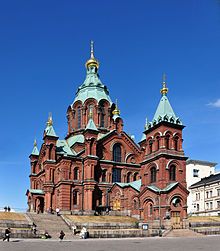
Senate Square
Our next stop was Senate Square. This town square has historical significance. Helsinki was destroyed in 1809 and was begun to be re-built in 1812. The re-building of Helsinki started at Senate Square. In the center of the plaza is a statue of some national hero. The square is surrounded by large, impressive buildings. The Lutheran Cathedral stands on one side of the square. It is accessed by an enormous set of steps that extends all the way across that side of the plaza. There are 25 steps, then a small platform, and then another 22 steps that ascend to the Cathedral, giving it a very majestic appearance. The exterior of the Cathedral is beautiful. There are columns across the front; there are statues of the 12 apostles at various points on the roof, and there is a large green dome in the center of the roof, surrounded by 4 smaller domes. The interior of the Cathedral is very simple and plain, with the two most prominent features being the pulpit and the organ. There aren't usually statues in Protestant churches, but this Cathedral contains 3 statues of what was referred to as "Protestant Saints": Martin Luther, Philip Melancthon (who was a German reformer and Martin Luther's collaborator), and Mikael Agricola (who is responsible for bringing Lutheranism to Finland). Besides the Cathedral, the other buildings that border Senate Square are the Senate Building (which is now the Prime Minister's office) and other government buildings, a cafe, the National Library, and the University of Helsinki.
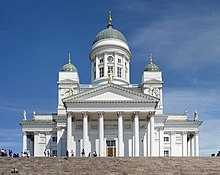
Temppeliaukio Church
Our second stop on our city tour of Helsinki was at Temppeliaukio Church, also called Rock Church. This is a Lutheran Church that was built in 1969 by blasting into hard granitic rock. Some of the surrounding rock was left in place, and the end result is a church sitting in a depression surrounded by rock walls - very unique, and very beautiful. The ceiling consists of a 13 mile long coil of copper ribbon wound in a circular pattern and a skylight dome. The acoustics are fantastic, and there are many concerts held here. Kirta pointed out that people love to go to church to attend weddings and concerts and other events, but that the Sunday services are usually empty. Most people in Finland are Lutheran affiliated (about 80%), with a small percentage being Orthodox. Even though Lutheranism is predominant, there are 2 "national" churches of Finland: Lutheran and Orthodox. (Catholics comprise around 1% of the Finnish population.) Finland has a "church tax", where 1-2% of income is taxed and given to state-recognized churches. The money is used mostly for the maintenance of the property and buildings, which have a high cultural value, rather than to promote religion, as Finland is a highly secularized country.

Sibelius Monument
Our ship left Stockholm and traveled through the night to Helsinki. We had noticed that the swells seemed pretty big, and then this morning the cruise people informed us that during the night we had encountered 15-18 foot waves, and 58 mph winds, which caused us to have to slow down. As a result, we ended up getting into Helsinki a little late. Some of the earlier tours were delayed slightly, but our tour wasn't scheduled until 10:45, so we weren't affected by the delay. We began our day with a bus tour of the city of Helsinki. Our bus had a local tour guide named Kirta, who was very informative and also very entertaining. As we drove around the city, Kirta pointed out places of interest, and we stopped and got off the bus at a few of the more interesting sights. The first stop was the Sibelius Monument. This is a monument that consists of over 600 pipe-organ pipes welded together. It is meant to honor, and is named for, the national composer of Finland - Jean Sibelius. When the woman originally created the sculpture and put it in the city park, it immediately caused an uproar. It was not obvious what the sculpture was meant to be; some people thought it was cigars, others thought it might be a depiction of the northern lights, while still others thought it was perhaps an oil rig. They were outraged that this hideous thing had been placed in a beautiful green park. When they were informed what it was, they insisted that the sculptor create a bust of Sibelius' face and place it next to the pipe-organ display to clarify it. She complied, and the monument has been in place over 50 years. The people of Helsinki now love it and in fact are very proud of it.
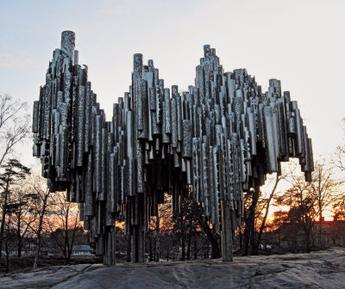
Monday, September 4, 2017
Stockholm
Mon., Sept. 4 - This morning we took a Viking bus tour of the city of Stockholm. We learned some interesting things about the culture and history of Sweden. We learned about VASA, which is a Swedish warship that was built in 1628. At the time it was the largest in the world, containing 64 large cannons. The only problem is that it was not built properly, as it was top heavy. As soon as it sailed away from the dock, it sunk in the middle of the river not far from where it was docked. It remained sunken for 333 years, but because it was encased in mud and was in cold water, it was well preserved. Eventually it was raised and restored and today is a tourist attraction located in the VASA Museum.
Stockholm is an interesting city geographically. The actual city of Stockholm consists of 14 islands, with 20,000 total islands in the area comprising an archipelago, making for a beautiful setting. Thousands of Swedes maintain summer homes on the islands of the archipelago. Stockholm's official date of origination is 1252, and it's existence is due to it's prime location along the trade routes in the Baltic Sea. Stockholm is home to about 1 million people.
On our tour, we passed by Stockholm's smallest theater, which consists of a one-woman show. The lady who runs the place is the owner, sole actor, ticket taker, cleaning lady, etc. The theater itself has 17 seats.
The oldest part of Stockholm is called Gamla Stan. The old buildings, churches, shops, restaurants, and cobblestone streets make it one of the more popular tourist destinations.
Sweden's government is a constitutional monarchy, with a King and Queen where the King is the head of state. There is a 349 member Parliament composed of 9 different parties, with the two most numerous ones being the Green Party and the Socialist Party. The parties in Parliament elect their head of government, the Prime Minister.
Sweden, like Iceland and the other Scandinavian countries, is mostly Lutheran. Stockholm is where the Nobel prize is awarded. We passed by the building where the ceremony takes place and the award is given out. The King is the one who actually presents the award to the winner.
Stockholm consists of 1/3 parks and green areas, 1/3 water, and 1/3 land living area. On our tour, we passed by the Grand Central Station (subway system), City Hall, and the home of the Nobel family, who also is responsible for the invention of dynamite, in addition to the prize bearing the name. Our tour guide told a story about how during the invention process, many accidents occurred, and the family was finally asked to leave town for safety reasons.
We were told about an ice bar in the city, where you are provided with a cape and gloves upon entering. Everything is made of ice: the bar, the stools, even the glasses that you drink out of. There was also an ice hotel that was built in Northern Sweden. Our guide told us that they have to re-build the ice hotel every year because it melts in summer. (I suppose one day they might figure that out and use a different building material.)
We also drove by Olympic Stadium, which is where the summer olympics of 1912 were held. We were told of a story that occurred during those Olympics. When they ran the marathon, there was a Japanese fellow who got half way through the marathon and then decided to stop for a drink. He got friendly with the people he was drinking with and then stayed for lunch, and then for dinner. He never did get back to the marathon. An article about him was written in the local paper at the time. Many years later, a journalist came across the article and made it his mission to locate the guy. He found the Japanese guy, who was now in his 80's, persuaded him to come back to the stadium in Stockholm and finish the marathon, which he did. It is now on record as the longest time ever run in the olympics marathon.
We drove through one of the islands of Stockholm called Djugarden. On this island is the VASA Museum where the aforementioned restored VASA ship resides, an amusement park, an open air historical museum with old farm houses and restored buildings, some green parks, a nice walk along the harbor, and a building which serves as a venue for musical concerts. Apparently there was a little start up group from England that played here in the 1960's, a group called The Beatles. The music group Abba has its own museum here. One of the band members operates his own hotel where many famous musicians stay.
We also drove by the Royal Palace where a guard was standing duty outside. We drove by a Catholic Church and were told that for the first time ever, Stockholm now has a Cardinal as Pope Francis named the Bishop of Sweden a Cardinal in June of this year. We also saw the largest round building in the world. Here they play ice hockey, have musical concerts, and once had a Mass said by the Pope there. The name of the building is called The Globe, which I guess is a good name for the world's largest round building.
Stockholm is an interesting city geographically. The actual city of Stockholm consists of 14 islands, with 20,000 total islands in the area comprising an archipelago, making for a beautiful setting. Thousands of Swedes maintain summer homes on the islands of the archipelago. Stockholm's official date of origination is 1252, and it's existence is due to it's prime location along the trade routes in the Baltic Sea. Stockholm is home to about 1 million people.
On our tour, we passed by Stockholm's smallest theater, which consists of a one-woman show. The lady who runs the place is the owner, sole actor, ticket taker, cleaning lady, etc. The theater itself has 17 seats.
The oldest part of Stockholm is called Gamla Stan. The old buildings, churches, shops, restaurants, and cobblestone streets make it one of the more popular tourist destinations.
Sweden's government is a constitutional monarchy, with a King and Queen where the King is the head of state. There is a 349 member Parliament composed of 9 different parties, with the two most numerous ones being the Green Party and the Socialist Party. The parties in Parliament elect their head of government, the Prime Minister.
Sweden, like Iceland and the other Scandinavian countries, is mostly Lutheran. Stockholm is where the Nobel prize is awarded. We passed by the building where the ceremony takes place and the award is given out. The King is the one who actually presents the award to the winner.
Stockholm consists of 1/3 parks and green areas, 1/3 water, and 1/3 land living area. On our tour, we passed by the Grand Central Station (subway system), City Hall, and the home of the Nobel family, who also is responsible for the invention of dynamite, in addition to the prize bearing the name. Our tour guide told a story about how during the invention process, many accidents occurred, and the family was finally asked to leave town for safety reasons.
We were told about an ice bar in the city, where you are provided with a cape and gloves upon entering. Everything is made of ice: the bar, the stools, even the glasses that you drink out of. There was also an ice hotel that was built in Northern Sweden. Our guide told us that they have to re-build the ice hotel every year because it melts in summer. (I suppose one day they might figure that out and use a different building material.)
We also drove by Olympic Stadium, which is where the summer olympics of 1912 were held. We were told of a story that occurred during those Olympics. When they ran the marathon, there was a Japanese fellow who got half way through the marathon and then decided to stop for a drink. He got friendly with the people he was drinking with and then stayed for lunch, and then for dinner. He never did get back to the marathon. An article about him was written in the local paper at the time. Many years later, a journalist came across the article and made it his mission to locate the guy. He found the Japanese guy, who was now in his 80's, persuaded him to come back to the stadium in Stockholm and finish the marathon, which he did. It is now on record as the longest time ever run in the olympics marathon.
We drove through one of the islands of Stockholm called Djugarden. On this island is the VASA Museum where the aforementioned restored VASA ship resides, an amusement park, an open air historical museum with old farm houses and restored buildings, some green parks, a nice walk along the harbor, and a building which serves as a venue for musical concerts. Apparently there was a little start up group from England that played here in the 1960's, a group called The Beatles. The music group Abba has its own museum here. One of the band members operates his own hotel where many famous musicians stay.
We also drove by the Royal Palace where a guard was standing duty outside. We drove by a Catholic Church and were told that for the first time ever, Stockholm now has a Cardinal as Pope Francis named the Bishop of Sweden a Cardinal in June of this year. We also saw the largest round building in the world. Here they play ice hockey, have musical concerts, and once had a Mass said by the Pope there. The name of the building is called The Globe, which I guess is a good name for the world's largest round building.
Arrival in Stockholm
Sun., Sept. 3 - We spent most of the day Sunday traveling. As posted earlier, we flew from Raykjavik on a 7:30 a.m. flight, which took off about an hour late. We landed in Stockholm about 11:30, but due to the time change, it was 1:30 local time. The Viking people met us at the airport, and for some reason we did not have to go through customs. We're assuming it was a blanket custom check through Viking, with Viking most likely providing the airport officials our passport info. At any rate, it was great. We already like the Stockholm airport better than Reykjavik! We boarded buses and traveled for about an hour to our cruise ship. We checked into our cabin, found something to eat, took a nap, ate dinner at the Italian Restaurant on board, and then slept some more. Fortunately for us there were no cruise activities planned for today, other than sleeping and eating, both of which were much needed, especially sleeping.
The Reykjavik Airport
Sun., Sept. 1 - Early Sunday morning, like very early, we headed for the Reykjavik airport for an early flight to Stockholm, Sweden, where the actual cruise will begin. We were told to meet in the lobby of the hotel at 3:45 a.m. to take the bus to the airport. We were given a "Grab and Go" breakfast to eat on the bus. We arrived at the airport, checked our bags, found our gate, and awaited our plane's departure to Stockholm. Now we really enjoyed our time here in Iceland. We saw a lot of beautiful things and there were some very interesting sights, and we highly recommend visiting this country. But we have to say that we absolutely HATE the Reykjavik airport. It is the absolute worst airport we have ever been in. The concourses are very narrow, and then as you walk down the concourse, there are long lines of people standing along the wall, waiting to board their plane, as they do not have gate areas in some parts of the airport. Where there are actual gate areas for waiting to board a plane, there are sometimes only two seats, sometimes 8 or 10, and sometimes a few more, but never large areas. As a result, people are scattered about on floors, in between chairs, anywhere they can find space to sit (or sleep) while awaiting their plane. Presumably the airport is overcrowded partly due to the recent increase in tourism. When we lined up to board our plane, there were herds of people all around us, and when the boarding began, there was no defined line that moved forward, just a bunch of people all lurching forward together as time and space allowed. The Reykjavik airport apparently doesn't have enough gates for the plane traffic, and so many planes have to "park" away from the gate and then bus the passengers to the terminal. This was the case upon our arrival, and unfortunately was the case again upon our departure. As we finally managed to get to the front of the line where the buses were boarding, the bus was full and we had to wait for the next bus. After a very long time, the next bus finally arrived and we boarded it. They tried to get all remaining passengers on this bus, so we were packed in like sardines, and then had to wait about 20 minutes with no explanation of what we were waiting for. Finally after what seemed like a very long time, the doors closed, and the bus pulled away from the curb. It drove for about 10 or 15 seconds, and then stopped at our plane. ARE YOU KIDDING ME??!!! We could have walked there and back 10 times during that time we spent packed like sardines on the bus! And then a very scary thought occurred to me - we have to travel through Reykjavik airport on our way back home in a couple of weeks! NOOOOOOO!!!!!
The Blue Lagoon
Sorry, this post was supposed to be published before the last one. Saturday afternoon we traveled by bus from Reykjavik to the Blue Lagoon, one of the 25 "Wonders of the World". The Blue Lagoon is located 24 miles from Reykjavik. We went for a swim in the warm, soothing, relaxing geothermal waters. The pool was built into the surrounding lava fields, and you walk on an impressive path with moss-covered lava walls on either side of the path to get from the parking lot to the lagoon area. The waters of the blue lagoon are of a greenish-blue color, and is loaded with minerals such as silica and sulfur. The temperature of the water is a constant 99-102 degrees. Even though the temperature of the water is warm, the air is still pretty cold, so the lagoon was built in such a way as to offer access from the indoors by a zero-entry water ramp which goes directly to the outdoor area of the pool from inside, without having to walk out into the cold air. This was really nice, especially when exiting the pool. There was a viewing area for those who didn't want to go in the water. There was a big picture window where they could look out onto the lagoon below. Because of the constant rain, however, viewing could be difficult. So they solved this problem by installing a giant 5-foot high windshield wiper that moves slowly back and forth across the large window. Sitting around in the Blue Lagoon was so relaxing, it was unbelievable. You could feel the thickness of the minerals in the water, and could experience the buoyancy. It was a great experience.


More Interesting Things About Iceland
Before we leave the country of Iceland, we'd like to share a few more things we learned about this unique country. The most common building material for houses here is concrete. This makes for a drab appearance as you drive around the city. All the roofs are metal. The reason for the concrete and metal is because of the weather. According to our local tour guide, it rains in Iceland "from all directions". We certainly have experienced some of that during our time here. Most people in Iceland buy rather than rent, which causes a problem for young people who cannot afford to buy. We were told that the politicians are working on that. We noticed that there was a lot of new construction going on in Reykjavik, as they are building many new hotels. They can not keep up with the demand due to increased tourism. Our tour guide said that many Icelanders are still in awe that people actually make Iceland a vacation destination. She said that if you told her when she was growing up that people would come here from all over the world to see the Northern Lights, she would have thought you were crazy. The local people in Reykjavik do also enjoy the Northern Lights just as tourists do. Our tour guide told us that before going out to view the lights, they check a local website that monitors cloud cover and sun spot activity in order to locate the best viewing areas. They then drive "into the dark" anywhere from 30 to 50 miles from Reykjavik, leaving around 10 p.m., spend a few hours watching the "light show", and then return home at 2 or 3 in the morning. The lights have already been seen here this season as we were told that there was a "northern light" sighting last week. And one last tidbit about this beautiful but in some ways unusual country. Iceland maintains a list of approved names. When an Icelander gives birth, the new child must be named from this list. The list is maintained by the Icelandic Naming Committee, which consists of three people who were appointed by the Minister of Justice. There are 1,712 male names and 1,853 female names on the list. If you would like to name your child by a name that is not on the approved registry, you can submit the name to the Naming Committee for approval. They will review it and then let you know if you are allowed to give your child that particular name. The committee will check the name to see if it is compatible with Icelandic tradition, and they also check for the likelihood that it might cause embarrassment to the person bearing the name. Oh, and you are not allowed to give your child a name that does not match the grammatical gender of the child. All Iceland men bear the surname of their father plus the word "son"; for example, Edward Johnson. The women bear the name of the father plus the Icelandic word for daughter, which is dottir; for example, Harriet Johnsdottir. Therefore a brother and sister will not share the same surname. Because of the oddities of the names in Iceland, the phone book is listed in alphabetical order by first name.
Sunday, September 3, 2017
Reykjavik Bus Tour
Sat., Sept. 2 - We spent Saturday morning on a bus tour of Reykjavik. The bus drove around the city while the tour guide pointed out interesting sights. Some of the places we saw include Hofdi House, where Reagan and Gorbachev met in 1986 at a Summit meeting that resulted in the beginning of the end of the Cold War. We also saw where the famous chess match was held between Bobby Fischer and the Soviet Union defending champion in 1972. It was called the match of the century. At the time they were trying to decide where to hold the match, kept changing the chosen location, and ended up deciding on Reykjavik. Many people were surprised and wondered why Iceland. We passed by more swimming pools and were told again how popular swimming is in Iceland. Most people swim in the mornings before work, and children here are required to learn how to swim, beginning at age 5. We drove by the Old Harbor where there are many boutiques, restaurants, shops, and of course boats, which offer whale watching and Puffin watching trips. We drove by the largest and most famous church in Iceland, Hallsgrimskirkja Lutheran Church. The exterior of the church resembles columns of basalt, in keeping with the geological theme of Iceland. The inside of the church is fairly plain, but with a particularly interesting phenomenon: the pews have movable backs. You can shift the back of the bench-like pew so that they can face either forward or backward toward the rear of the church. Or I suppose you could move some of them and not others so that people can face each other. There was a sign for the tourists asking that they please not move the pews. There is a large statue in front of the church, and you'd think it would be a statue of a saint but it was a statue of Leif Erickson. No explanation as to why Leif Erickson's statue graced the front of the church.

We also drove by City Hall which is situated on the edge of a pond with ducks and pedestrian bridges, and bordered by nice flowers in a park-like setting. We passed a laboratory where they are conducting Genome research and were told that they are using local Icelanders in their research due to their isolation from other people. We passed some foreign embassies and the National Museum. Then we made a stop at The Pearl, which is Iceland's oldest university. It is called The Pearl because it has a white dome top and from a distance resembles a pearl. We went to an observation deck there where we were afforded beautiful views of the surrounding city of Reykjavik. We ended our morning tour with a stop at the Open Air Museum, which is a collection of houses, farms, and a church in a setting which shows what life was like in Reykjavik in earlier times. Inside the church, they had us sit the way people did back then, with women all on the left side and the men on the right.


We also drove by City Hall which is situated on the edge of a pond with ducks and pedestrian bridges, and bordered by nice flowers in a park-like setting. We passed a laboratory where they are conducting Genome research and were told that they are using local Icelanders in their research due to their isolation from other people. We passed some foreign embassies and the National Museum. Then we made a stop at The Pearl, which is Iceland's oldest university. It is called The Pearl because it has a white dome top and from a distance resembles a pearl. We went to an observation deck there where we were afforded beautiful views of the surrounding city of Reykjavik. We ended our morning tour with a stop at the Open Air Museum, which is a collection of houses, farms, and a church in a setting which shows what life was like in Reykjavik in earlier times. Inside the church, they had us sit the way people did back then, with women all on the left side and the men on the right.

Friday, September 1, 2017
Interesting Things We Learned About Iceland
Iceland's surface is 11% lava covered and 12% glacial covered, hence the nickname "Land of Fire and Ice." The weather here is not as cold as you would think (especially for a country that goes by the name of ICE-land). We were told that the temperatures in the winter are just below freezing and the temperatures in the summer are usually in the 50's. The state religion is Lutheran. There is only one Catholic church in Reykjavik. There are only 18,000 Catholics in the country, most of them are from Poland. There are 7 universities in the country, with three of those being in Reykjavik. The top industries are 1) tourism, 2) fishing, and 3) aluminum (or as our local tour guide pronounced it, al-you-min-ium). There is no aluminum ore found in Iceland; the aluminum ore is shipped from Australia. But the reason aluminum is such a big industry here is because it takes a lot of power to make aluminum, and power is very cheap here. Fishing used to be the top industry, but recently was passed by tourism. The main reason for the increase in tourism stems from the publicity the country received in 2010 when the volcanic eruption halted air traffic and thus garnered international attention. It turned out to be a blessing in disguise for Iceland, as people learned about the unique beauty of the country and tourism then began to flourish. Iceland does not have an army, only a coast guard to protect the valuable fishing industry. Bananas are actually grown in Iceland, making it the only country in Europe to export bananas. Much of the landscape of Iceland consists of moss-covered lava. There are 600 different species of moss here. Iceland is almost treeless, as only 1% of the country is wooded. There are no snakes in Iceland, and no mosquitoes. There is a polar bear problem. Polar bears come to Iceland from Greenland by either swimming or floating on ice. Greenland is only 168 miles from Iceland, and in fact you can see Greenland from a certain point in Iceland. When the polar bears arrive in Iceland, they are immediately killed because there are no facilities here to care for them. Greenland doesn't want them back because of potential diseases. There are many farms that dot the countryside of Iceland: horse farms, sheep farms, and dairy farms. The sheep farmers share the hillsides where the sheep graze, but it doesn't cause problems, we were told, because every farmer knows his own sheep. (I know a Shepherd who knows His own sheep and calls them by name.)
Kerid Crater
Iceland is a volcanically active country and therefore contains many craters. The most dramatic of these is the Kerid Crater. The Kerid Crater contains a crater lake, which formed by explosion of the volcanic cone and the subsequent implosion of the remaining crater. Water then filled the crater, creating the crater lake. The water in a crater lake has no outlet, so there is no drainage of the water, making it a good indicator of water table levels. There was an overlook where we had a nice view of Kerid Crater, with red hills surrounding the crater and green lake water at the bottom of the crater - very impressive.


From there, we continued our drive, now heading back to Reykjavik. Along the way we saw many greenhouses that use geothermal waters for heating. This is the heart of horticultural in Iceland. We were told that 90% of homes in Iceland are heated with geothermal power. Power is very cheap here. We passed by the largest power station in the world. One more word about Iceland volcanoes - Iceland's most famous and active volcano is Hekla. Everyone here is afraid of Hekla. It has erupted many times. It generally erupts every ten years. The last eruption was in 2000, so it is overdue. The name Hekla means "Hooded One" and Hekla is so named because often its top is shrouded in fog or mist.
Gulfoss
We next traveled to a waterfall called Gulfoss. In Iceland, foss means waterfall, so when you see a word ending in "foss", it is referring to a waterfall. Some examples are Gulfoss, Dettifoss, and Godafoss. The word Gulfoss means "Golden Falls". Gulfoss is Iceland's most famous waterfall and the largest in Europe. There was an opportunity to view the waterfall from above, and then to descend some steps and follow a path to view the falls down below. Our tour guide was so enthralled with the idea of standing next to the falls, where you could feel the earth shake as the water tumbled over the rocks, that she exclaimed "Feel the power of Gulfoss!" The falls occur where the Hvita River drops 96 feet and creates a double cascade, making for incredible scenery. Below the falls, the river continues to flow down a narrow ravine.


Geysir
After Thingvellir, we traveled to a geyser called Geysir, located in a geothermal park. Geothermal waters abound in Iceland. As a result, there are many swimming pools here. It is very cheap to maintain the pools since they are heated by the geothermal waters. As we approached Geysir (pronounced gay-zeer) the countryside became a steaming hillside. It looked very much like Yellowstone. As we approached the entrance to the geothermal park, the whole landscape was steaming (which looked like smoke rising) and so we enjoyed the irony of the "No Smoking" sign at the entrance. There was also a sign at the entrance with a list of important items such as Do not touch the water because it is 200 degrees, Stay on the marked paths, Do not break or collect sinters (whatever that is), and for the rule-breakers, the last item on the list was that the nearest hospital is 62 km away. The main attraction of this geothermal park was the geyser named Geysir, which is the original hot water spout. In fact, our English word geyser comes from Geysir. Geysir erupts every 5 to 10 minutes. We observed it erupt twice while we were there. One more word about the geothermal waters - the earth here is so warm that they commonly bake bread by placing it in the ground. After the visit to the geothermal park, we ate lunch at a nearby restaurant. During lunch we had the opportunity to meet some of our fellow travelers. We met 4 women from Arizona who are traveling together. And we met Kip who is originally from Edmonton, Canada, but who lived in Venice, Louisiana briefly, and Kip's wife Alice from Dallas.


Subscribe to:
Posts (Atom)